NWWI Valuation Report in Rotterdam: What Validation Means
Understand how NWWI validation works for a Rotterdam valuation report, what it checks, when a lender may require it and which questions to ask first.

An NWWI valuation report in Rotterdam is a residential valuation report submitted by an affiliated valuer for review within the NWWI process. NWWI report review adds a report-level check. The valuer, the report recipient and the lender still have separate roles. Start by confirming whether the recipient accepts or requires NWWI for your property and purpose.
TL;DR
The useful order is to confirm the lender, accepted report form, report review, valuation date and delivery conditions before ordering work.
If a lender is waiting for your file, write its recipient, purpose, accepted report form and valuation date before you request work.
Before you compare the report, align your purpose, recipient and evidence with NRVT residential valuation practice guidance.
For this assignment, keep the relevant property or file facts beside NHG valuation requirements before you rely on the conclusion.
When your file raises a related question, compare the facts with what is a property valuation report before you choose the report scope.
When your file raises a related question, compare the facts with mortgage valuation Rotterdam before you choose the next step.
Before you compare the report, align your purpose, recipient and evidence with NRVT residential valuation practice guidance.
For this assignment, keep the relevant property or file facts beside NHG valuation requirements before you rely on the conclusion.
When your file raises a related question, compare the facts with what is a property valuation report before you choose the report scope.
When your file raises a related question, compare the facts with mortgage valuation Rotterdam before you choose the next step.
Context that informs this decision
- The professional: Is the person qualified and independently able to perform the work? The person named for the report should match the public NRVT Register-Taxateur record before the report is ordered.
NWWI report review adds a separate control to the report brief; valuation report contents define the underlying document fields.
The wider lender file sits within mortgage valuation, while mortgage valuation requirements identify the recipient’s form and deadline.
The person-level question is answered by registered property valuer checks.
If you are an expat borrower, keep mortgage documents separate from valuation report review by listing the mortgage documents expats need in the Netherlands before the valuation brief is final.
If the wording from the recipient is confusing, contact Taxateur Rotterdam Pro with your question.
The person-level question concerns the registered valuer record; a broad credential word concerns certified property valuer checks.
NHG residential valuation rules that a fully validated valuation report or an approved hybrid valuation is needed for an NHG mortgage under its conditions, and it names NWWI as an accepted report review institute.
A physical report and a hybrid report answer different acceptance questions; NHG report comparison distinguishes those forms.
What is NWWI report review?
NWWI report review is a review of a submitted valuation report. The NWWI consumer leaflet explains that an affiliated valuer prepares the report, submits it for report review and responds when the review raises a question. A digitally signed report can then be delivered to the client.
The useful short definition is this: NWWI report review is a review process for a submitted valuation report, used when the receiving party accepts or asks for that form of assurance. It does not turn every valuation into a guaranteed loan decision or a guaranteed market value.
Why it matters for the file
Mortgage files often connect three checks that should stay separate:
-
The report: Does the valuation explain the property, date, purpose, evidence and assumptions clearly enough for review?
-
The recipient: Does the lender, adviser or other party accept this report form for this product and property?
How an NWWI report moves through the process
The NWWI question begins after the report purpose is defined.
Write down the property address, intended recipient, purpose, required date and report form.
Send those five details to the valuer or adviser and ask whether NWWI report review is part of the accepted process.
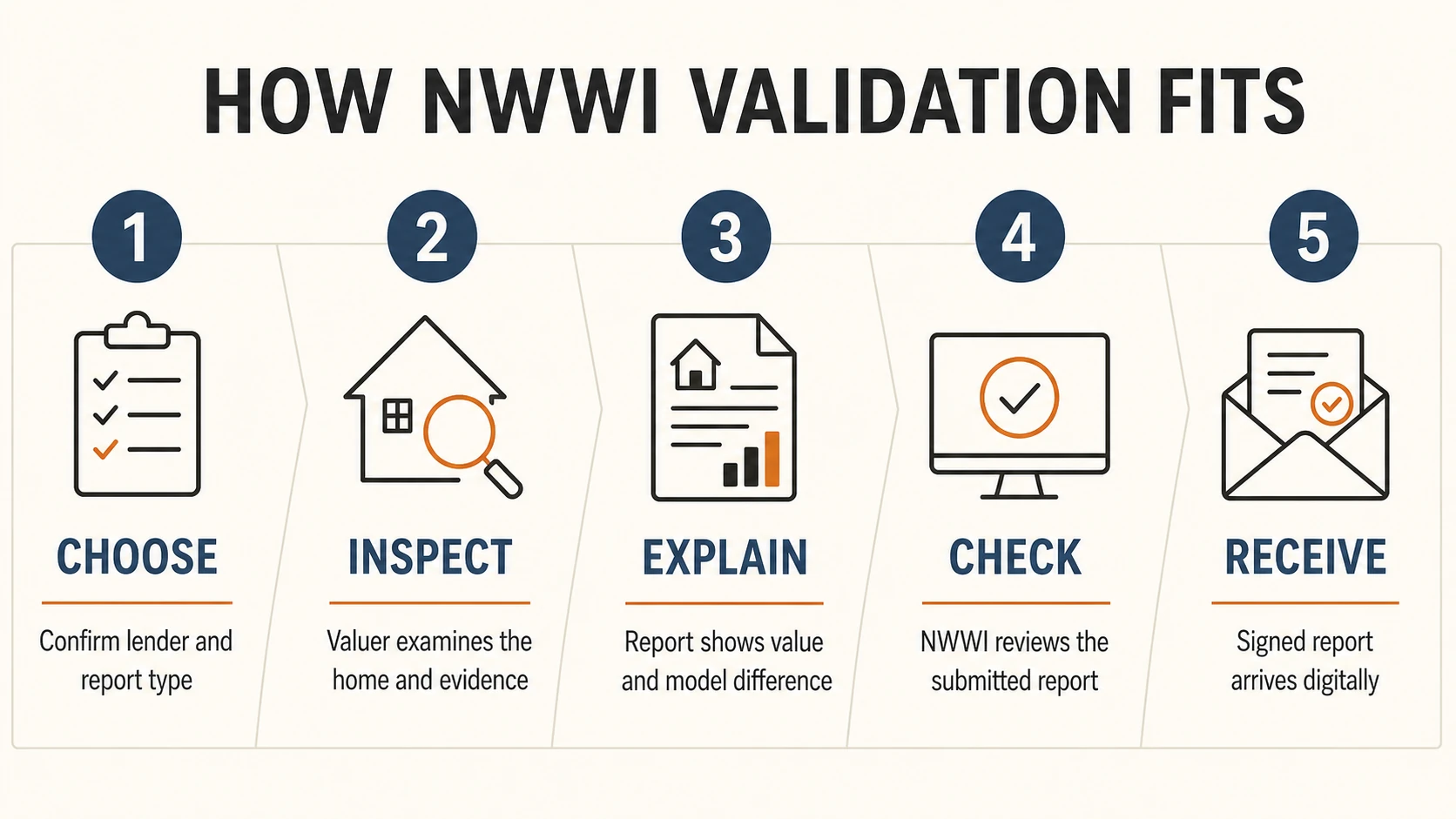
1. Choose the report type
Ask the lender or adviser what it accepts before you book an appointment. Confirm the property, purpose, report form, report review and delivery deadline. An NWWI request may be appropriate for one mortgage product and unnecessary for another.
2. Inspect the home and evidence
The valuer examines the home and the information supporting the assignment. Give a complete brief about apartment rights, leasehold, extensions, permits, maintenance, energy work and unusual use. A missing fact can lead to a question later in the process.
3. Explain the value and evidence
The report sets out a market value for a stated date and purpose. The NWWI leaflet describes the valuer explaining differences between model values and the valuer’s own conclusion through professional knowledge and local knowledge. The report should make its assumptions and supporting evidence understandable to the intended reader.
4. NWWI reviews the submitted report
NWWI checks the submitted report within its report review process. A question from the review does not automatically mean the value is wrong. It means the valuer must clarify, correct or support a point before the report can move forward.
5. Receive and check the signed report
After the process, the report can be sent digitally. Read the address, purpose, date, property description, value, assumptions, limitations and report review details. Send it to the intended recipient only after those details match the mortgage or other decision.
What the report can show
An NWWI report can bring several useful pieces of evidence together:
- the property and legal position described for the assignment;
- the market value and valuation date;
- comparable sales and other evidence used by the valuer;
- an explanation where a model indication differs from the valuer’s conclusion;
- assumptions, limitations and unusual property facts;
- the report review status and any questions answered during review.
The exact content depends on the report form and purpose. Ask the recipient which fields it needs before the inspection.
NWWI, NRVT, NHG and lender acceptance
NWWI and NRVT answer different questions
NRVT registration concerns the professional person. NWWI report review concerns a submitted report. A registered valuer can prepare different report types, while NWWI involvement belongs to the report and its intended use.
NWWI and NHG are connected only in a defined context
The lender and current NHG rules still determine what applies to the individual file.
Cost and timing: use the date on the source
The NWWI consumer leaflet dated 2024-1 lists a separate NWWI contribution of €55.59 including VAT, or €45.95 excluding VAT. Treat those amounts as a dated source reference, not as a current quotation. Ask the valuer which contribution applies now, whether it is included on the offer and what happens if the report requires a revision.
The work can also depend on the inspection schedule, missing documents, review questions and the lender’s deadline. Ask for the handoff date rather than assuming that report review ends on the day of the visit.
What NWWI report review does not decide
NWWI report review does not decide:
- how much a lender will lend;
- whether your income, debts or product conditions qualify;
- whether every lender accepts the report;
- whether a property fact omitted from the brief can be ignored;
- whether the market value suits a personal sale or purchase decision;
- which report age, inspection or hybrid conditions apply outside the stated product.
Rotterdam checks before submission
Give the valuer a clear file when the property includes:
- an apartment right, VvE documents or shared maintenance;
- leasehold terms, payment information or a possible buyout;
- a roof extension, altered floor area or unfinished renovation;
- foundation, water or maintenance information already known to you;
- a protected streetscape or unusual construction period;
- a purchase, refinancing or improvement purpose with a specific deadline.
These facts do not produce a value by themselves. They tell the valuer and reviewer where the evidence and assumptions need extra care.
Examples and edge cases
A purchase with a clear lender request
The buyer asks the lender whether an NWWI report is accepted, confirms the required value date and supplies the purchase agreement, apartment documents and renovation information. The valuer can prepare the report for the stated recipient, while the buyer checks the delivered report before submission.
Refinancing with a changed product
A homeowner has an earlier report and changes lender or mortgage product. The old report may not meet the new recipient’s form, date or report review conditions. The homeowner asks the new lender first rather than reusing the old report by assumption.
A question during review
NWWI asks for clarification about an extension or comparable sale. The valuer checks the plans and explains the point. The homeowner supplies a missing permit if requested. The question becomes part of the evidence trail instead of an informal correction sent outside the report.
When to use the term in a request
Use “NWWI valuation report” only after you can name the recipient, property, purpose and required report form. In an enquiry, ask:
- Does the recipient accept or require NWWI for this file?
- Which report form and valuation date apply?
- Which property and ownership documents are needed?
- Is a physical inspection required?
- Which current NWWI contribution is shown separately?
- What is the delivery deadline and who receives the signed report?
FAQ
Is an NWWI report the same as a valuation report?
An NWWI report is a valuation report that has been submitted for NWWI report review in the applicable process. The report review layer and the recipient’s conditions should be checked separately from the definition of a valuation report.
Does every mortgage need NWWI?
No single answer applies to every lender, product or property. Ask the lender or adviser what is accepted for the file before booking.
Does NWWI inspect the property?
The valuer inspects the property when the chosen report form requires an inspection. NWWI reviews the submitted report; it is not a substitute for the valuer’s visit or evidence gathering.
Is NWWI report review a guarantee that the report is accepted?
No. report review can satisfy one condition, while the recipient may also require a particular date, property description, form or delivery method. The lender makes its own acceptance decision.
Is the NWWI contribution included in the valuation fee?
It may be shown separately, depending on the offer. The 2024-1 consumer leaflet lists a separate contribution and an amount that must be checked against current information.
How old can an NWWI report be?
The permitted age depends on the recipient and purpose. In the cited NHG physical-report context, the report may be at most 6 months old from the valuation date. Confirm the current condition with the lender.
What if the report contains a question or correction?
Ask the valuer what evidence is needed and keep the answer connected to the report process. If the recipient’s request changes, confirm the new purpose or date in writing.
Can an NWWI report be used for a private sale decision?
That depends on the report purpose, date and the person relying on it. A lender-oriented report may not answer every question a seller or buyer has for a private negotiation.
Next step
Ask the lender or adviser whether NWWI is accepted for this property and report purpose, which report form is needed and how the current NWWI contribution is shown. If the request or fee line is unclear, contact us with the recipient's wording and your question.
Ask about an NWWI valuation report →