Property valuation in a business dispute: how to make the value question testable
Prepare a commercial property valuation for a business dispute by separating rights, income evidence, value date, method, assumptions and legal decisions.

A valuation in a real-estate business dispute is useful when it turns a disagreement into a defined evidence question. The brief should identify the property rights, income facts, value basis, date, purpose and recipient. It should also state the limits: a valuer can assess value and explain the evidence, while a lawyer, accountant or court decides legal entitlement and procedure.
If you are preparing a Rotterdam valuation file, name the decision, recipient, property facts and valuation date before you compare evidence.
TL;DR: make the disagreement testable
Start with the sentence the parties need to resolve: “What was the value of this property interest at the agreed date for this stated decision?” Add whether the dispute concerns a sale, shareholder exit, lease, damages discussion, accounting treatment or another issue. A vague request for “the right value” invites two different assignments.
Before you compare the report, align your purpose, recipient and evidence with NRVT commercial property valuation guidance.
For this assignment, keep the relevant property or file facts beside NRVT residential valuation practice guidance before you rely on the conclusion.
When your file raises a related question, compare the facts with commercial property valuation Rotterdam before you choose the report scope.
When your file raises a related question, compare the facts with what is a property valuation report before you choose the next step.
Before you compare the report, align your purpose, recipient and evidence with NRVT commercial property valuation guidance.
For this assignment, keep the relevant property or file facts beside NRVT residential valuation practice guidance before you rely on the conclusion.
When your file raises a related question, compare the facts with commercial property valuation Rotterdam before you choose the report scope.
When your file raises a related question, compare the facts with what is a property valuation report before you choose the next step.
Context that informs this decision
When the property is used for business rather than as a home, commercial property valuation in Rotterdam keeps property type, income and report purpose in the same brief.
Property valuation report contents helps you check whether purpose, identity, evidence and limits are visible.
For the person-level check, questions for choosing a reliable property valuer helps separate registration, scope, evidence and communication from broad marketing language.
If you are assessing disputed business property, treat a residential property valuation in Achtse Barrier-Gunterslaer as residential location evidence, then assess rights, leases and income for the disputed asset separately.
If the scope or independence question remains open, contact us about a business-dispute valuation with a short question and no confidential company records.
Why quality matters in a dispute
In a normal orientation conversation, a broad estimate may be enough. A dispute needs a file that another professional can follow. Property identity, rights, leases, income, costs, condition, market evidence, assumptions and uncertainty should be visible. A confident number without those inputs is difficult to test.
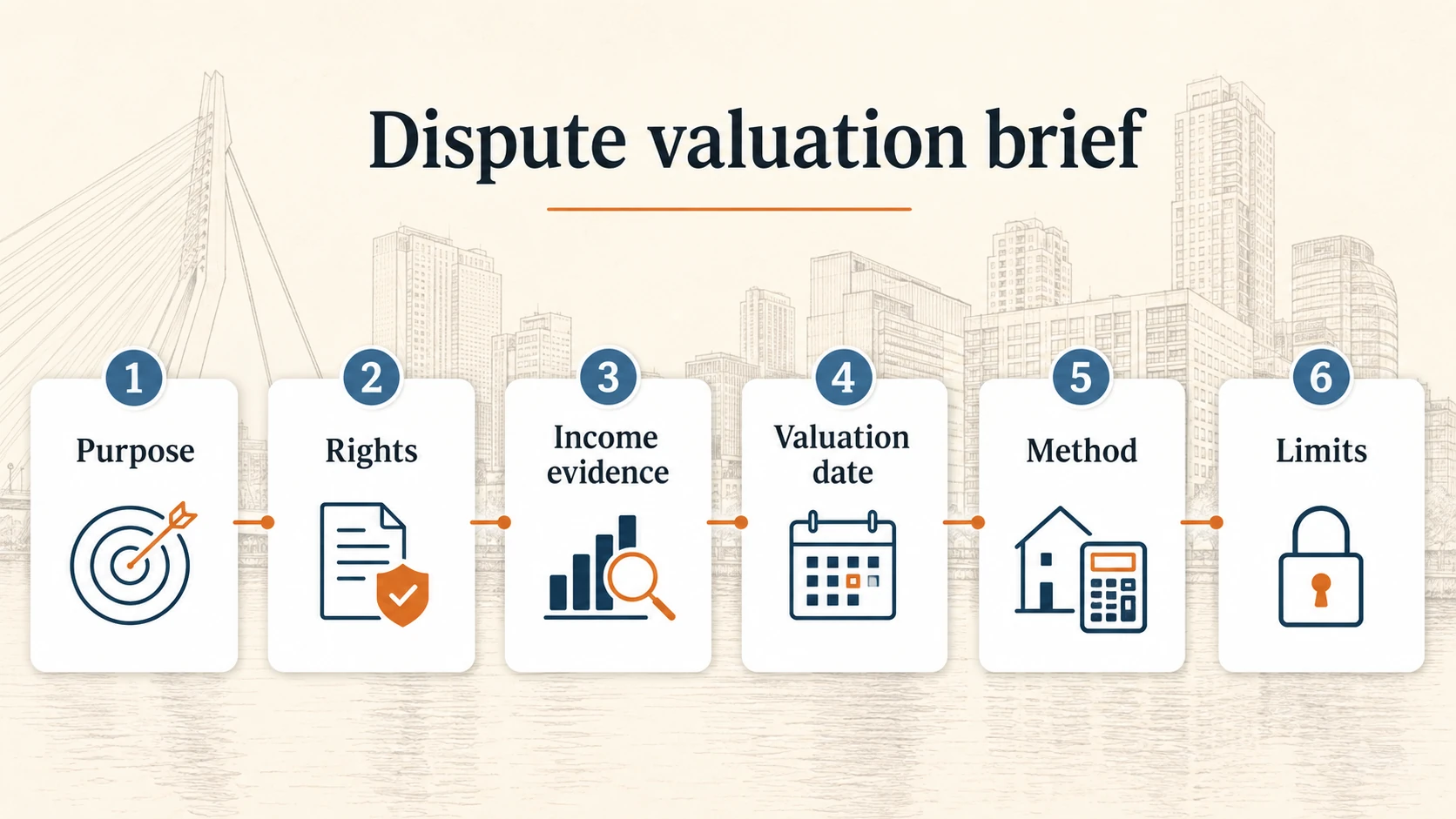
A six-field quality model
1. Purpose
Name the decision and the person who will use the report. A value for a sale negotiation is not automatically a value for a shareholder accounting question.
2. Rights
List ownership, leasehold, tenancy, easements, restrictions, options and any agreement that changes control or income. Ask which right is being valued, not just which building is being discussed.
3. Income evidence
For income-producing property, identify rent, vacancy, incentives, operating costs, service charges and the period to which each figure belongs. Keep supplied figures separate from verified records.
4. Value date
Record the value date, inspection date and report date. Historical assignments need a clear explanation of how market evidence and property condition at the earlier date are handled.
5. Method
Ask which valuation method fits the property and available evidence. A comparison, income or cost approach can require different records. The report should explain why the chosen method fits and where sensitivity remains.
6. Limits
Write down missing access, disputed documents, unusual rights, environmental questions, planning uncertainty and assumptions. A limit is useful when it tells the reader what could change the conclusion.
The finished document should state what the conclusion means and what it does not mean.
Prepare a concise brief with the property right, decision, value date, recipient, evidence available and disputed points.
Registration, independence and standards
Check the valuer’s current registration in the relevant public register and ask which professional rules apply to the assignment. Registration alone does not prove fit for every commercial question. Ask how conflicts, prior work for one party and confidential information will be handled.
The brief should make the independence question visible. If the valuer has advised one party, valued the asset for another purpose or has a financial relationship with a participant, ask whether the work can remain independent or whether a different professional is needed.
Experience that is worth asking about
Instead of accepting a broad claim of experience, ask for the property and evidence types the valuer regularly handles. Useful specifics include mixed-use buildings, leases, operating income, redevelopment assumptions, rights of use, partial interests and retrospective value dates. The answer should describe scope and method without disclosing another client’s confidential information.
Review before delivery
Use a staged review:
- Confirm the property identity, rights and instruction.
- Reconcile the supplied documents with the inspection and public records.
- Check the value date, market evidence period and property condition.
- Read the method, assumptions, calculations and sensitivity notes.
- Ask whether a reasonable reader could reproduce the reasoning from the report.
Red flags
- The assignment never names the right or decision being valued.
- The valuer promises a result before seeing the property file.
- A single rent or sale figure is used without a date or source context.
- A conflict question is brushed aside.
- Assumptions appear only after the conclusion.
- The report uses certainty language where records or access are incomplete.
Independent proof and reviews
Public registration, a clear scope description and an explainable process are stronger evidence than anonymous praise. Reviews may show communication experience, yet they rarely prove fit for a particular right, income stream or disputed value date. Ask for a written scope and a sample contents list that does not reveal another client’s data.
Questions before hiring
- Which property right and purpose will the report cover?
- What value date and recipient will appear in the report?
- Which records are needed for leases, income, costs and rights?
- How will access or disputed documents be recorded?
- How are conflicts and prior instructions checked?
- Which method is expected and what limits could affect it?
- Who can answer legal, accounting or procedural questions outside the valuation?
Balanced provider evaluation
Mark each answer as documented, partly documented or unclear. Give more weight to a specific scope, a clear independence answer, relevant evidence experience and visible limits. Keep a missing answer as a question; do not turn it into a negative fact about a provider.
Rotterdam signals
Local familiarity can help with property types, rights and evidence questions found in Rotterdam. It does not replace an assignment-specific review. Ask the valuer to name the local facts that matter for this property and explain how they enter the analysis.
Frequently asked questions
Can a valuation settle a business dispute?
It can provide a bounded opinion of value and show the evidence behind it. It cannot decide ownership, damages, accounting treatment or a legal remedy.
Should each party commission a separate valuation?
That depends on the agreement and the disputed question. Start by defining the purpose, right, date and recipient; a legal professional can advise on procedure.
What if one party controls the records?
List the missing records and the assumptions they create. Ask the valuer how the limitation will appear in the report and ask a lawyer about access or disclosure rights.
Is a commercial registration enough?
No. It answers a registration question, not whether the person fits this property, right, date and purpose. Review all four together.
A focused next step
State the property right, purpose, value date, recipient, disputed records and independence question. Legal and accounting professionals may need to confirm the wider process. Contact us about the valuation scope; do not send confidential company records, passports, contracts, bank details or other personal documents through the public form.
Contact us about a business-dispute valuation