Commercial property valuation in Rotterdam: 5 file layers
Understand the five file layers in a Rotterdam commercial property valuation: use, income, legal use, condition, method and sensitivity.

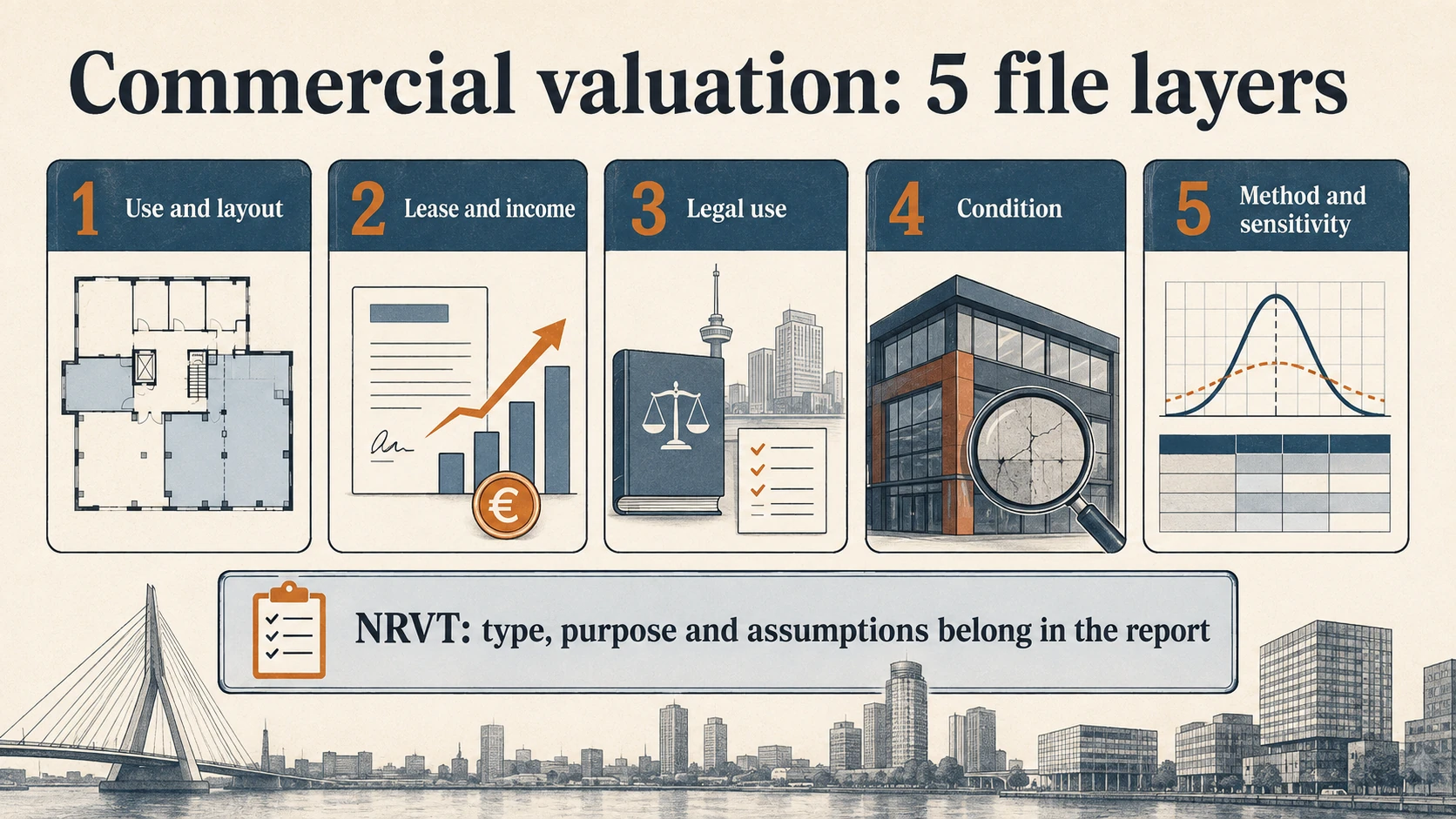
A commercial property valuation in Rotterdam needs a clear assignment and a layered evidence file. Start with use and layout, lease and income, legal use, condition, method and sensitivity. Those layers help the recipient understand how the conclusion was reached and which assumptions deserve review.
If you are preparing a business-property file in Rotterdam, separate use, rights, income and condition before you compare conclusions.
TL;DR: five layers to check
- Describe use, layout, access and the physical property.
- Gather leases, income evidence and operating assumptions.
- Check legal use, rights and restrictions.
- Record condition, maintenance and technical uncertainty.
- Confirm the valuation purpose, method, sensitivity and report recipient.
NRVT business-property guidance places the assignment, objectivity, evidence, method, uncertainty and plausibility in view. The visual turns that into five file layers.
Before you compare the report, align your purpose, recipient and evidence with NRVT commercial property valuation guidance.
For this assignment, keep the relevant property or file facts beside NRVT residential valuation practice guidance before you rely on the conclusion.
When your file raises a related question, compare the facts with what is a property valuation report before you choose the report scope.
When your file raises a related question, compare the facts with how to choose a reliable property valuer before you choose the next step.
Before you compare the report, align your purpose, recipient and evidence with NRVT commercial property valuation guidance.
For this assignment, keep the relevant property or file facts beside NRVT residential valuation practice guidance before you rely on the conclusion.
When your file raises a related question, compare the facts with what is a property valuation report before you choose the report scope.
When your file raises a related question, compare the facts with how to choose a reliable property valuer before you choose the next step.
Context that informs this decision
A recipient should be able to verify valuation report contents, including purpose, date, assumptions and evidence.
Independence, scope and communication are part of reliable property valuer selection.
A shortlist gains a clearer comparison from five commercial property valuer fit profiles in Rotterdam before quotes are requested.
When commissioning a commercial valuation, define the brief’s scope, outputs and experience requirements alongside valuation services in Eindhoven, then keep the evidence tied to the intended business property.
When a disagreement involves leases, rights or income, property valuation in a business dispute keeps the brief separate from a general commercial valuation.
Commercial files can compare home valuation in Rotterdam for property facts, while contents of a valuation report supply the recipient, date, assumptions and evidence checks.
Scope and audience
This explanation is for:
- business owners reviewing premises;
- investors and landlords preparing a valuation request;
- advisers checking a report’s scope;
- readers deciding whether they need a specialist in commercial property.
Taxateur Rotterdam Pro’s main subject is residential property. This page explains the questions around commercial-property valuation so you can identify the right scope. Ask whether a particular request fits the platform or needs a specialist whose regular work covers business property.
1. Use and layout
Describe how the property is used now and how the space is arranged. A warehouse, office, shop, mixed-use building and care property can have different evidence questions even when their floor areas are similar.
Prepare:
- floor plans and measured areas;
- current use by room or zone;
- access, loading, parking and service areas;
- shared spaces and tenant-specific fit-out;
- vacant, occupied and temporarily unused parts.
Ask the valuer to state which areas and uses belong to the assignment. A floor plan alone does not prove lawful use or income potential.
2. Lease and income
Income evidence can include leases, rent schedules, indexation terms, incentives, service charges, vacancies, arrears and operating costs. Keep the documents connected to the valuation date and the exact unit or building.
Clarify:
- who occupies each space;
- the rent, term, options and break rights;
- indexation and service-charge treatment;
- incentives, deposits and arrears;
- vacant areas and the evidence for an assumed letting.
Do not replace a signed lease with an informal rent expectation. If a market-rent assumption is needed, ask what evidence and uncertainty the report will show.
3. Legal use and property rights
Legal use is a separate file layer. Planning or zoning information, permits, leasehold, easements, access rights, environmental limits and division of ownership can affect what the property can do and how it should be valued.
Ask:
- Is the present use recorded and permitted?
- Are there restrictions on a change of use or building work?
- Who owns the land, building, fixtures and access?
- Are there easements, leasehold terms or shared facilities?
- Which documents should be checked by a legal adviser?
A valuation report can identify assumptions and evidence gaps. It does not replace legal advice on a complex right or planning question.
4. Condition and technical evidence
Record roof, façade, structure, services, installations, fire safety, accessibility, maintenance and known defects where relevant. Add inspection reports, invoices, planned work and environmental or technical information that affects the assignment.
Separate visible condition from future expenditure. A planned refurbishment is not completed work. Ask how the condition evidence, remaining life and maintenance assumptions will be handled.
5. Method and sensitivity
The report should state the valuation purpose, value basis, date, method or methods and important assumptions. NRVT business-property guidance also addresses uncertainty, sensitivity and plausibility. Those elements help the recipient understand which changes could move the conclusion.
Ask:
- Why does the selected method fit this property and purpose?
- Which income, vacancy, cost or market assumptions matter most?
- What evidence supports the main inputs?
- Which sensitivity or scenario checks are appropriate?
- How are limitations and uncertainty described?
The right method cannot be chosen from the property label alone. The assignment and evidence determine what can be tested.
Choosing the right specialist
Before you commission work, ask for:
- The specialist’s relevant commercial-property experience.
- Confirmation of independence and conflicts review.
- The exact purpose, recipient, value basis and valuation date.
- The document and inspection scope.
- The methods, assumptions, uncertainty and sensitivity checks to be reported.
- The process for reviewing factual errors before delivery.
Limits of a short commercial-property explanation
The five layers organise questions. They do not establish rent, yield, market value, legal use or borrowing capacity for a particular property. A report must use property-specific evidence and a stated assignment. If the request is outside a residential specialist’s normal scope, ask for a commercial-property referral or another qualified professional.
FAQ
Does every commercial property use an income method?
The appropriate method depends on the property, purpose, rights, income evidence and market context. Ask the specialist to explain the method choice.
Why do leases matter to value?
Lease terms affect income, timing, risk and evidence. The report should identify the lease facts and assumptions it uses.
Can a valuation decide whether a business use is legal?
No. Legal use and planning questions need the relevant official information and professional advice. The valuation can record the evidence and assumptions that affect its conclusion.
What does sensitivity show?
It shows how a conclusion may respond to changes in important assumptions. The relevant inputs depend on the property and assignment.
Can a residential valuer value a shop or office?
Ask about regular experience, scope and applicable professional guidance. Commercial property can require different evidence and methods.
Does this platform provide commercial valuations?
The platform’s main subject is residential property. Contact us with the request so we can clarify whether it fits the scope or needs a commercial-property specialist.
Next step
Write the property use, recipient, purpose, date, lease position and legal-use question in one brief.
Then ask a qualified specialist to confirm the scope and evidence list.
Write down the property use, valuation purpose, lease position, legal-use question, condition concerns and intended recipient. Ask whether the selected specialist covers commercial property and which method, evidence and sensitivity checks the assignment needs. If you want to confirm the scope first, contact us with your question.
Ask about valuation scope →