Property valuer in The Hague: how to evaluate the assignment
Evaluate a property valuer assignment in The Hague by registration, relevant experience, local evidence, independence, scope and report requirements.
Choosing a property valuer in The Hague starts with the assignment, not the city label. State the purpose, recipient, property facts, relevant registration, local evidence, independence, delivery and total scope before comparing professionals. Taxateur Rotterdam Pro publishes general valuation information with a Rotterdam focus; this information does not present a Hague office, address or provider directory.
For a local valuation search, name the city, street setting, property type and decision before you compare professional experience.
TL;DR: what makes a Hague assignment reliable?
A reliable choice is supported by a current professional identity, relevant experience with the property and decision, transparent scope, explainable evidence and a process that records assumptions and limits. A local-sounding name or a low fee cannot replace those checks.
Before you compare the report, align your purpose, recipient and evidence with NRVT residential valuation practice guidance.
For this assignment, keep the relevant property or file facts beside NRVT residential valuation practice guidance before you rely on the conclusion.
When your file raises a related question, compare the facts with property valuer in Rotterdam before you choose the report scope.
When your file raises a related question, compare the facts with property valuation costs Rotterdam before you choose the next step.
Before you compare the report, align your purpose, recipient and evidence with NRVT residential valuation practice guidance.
For this assignment, keep the relevant property or file facts beside NRVT residential valuation practice guidance before you rely on the conclusion.
When your file raises a related question, compare the facts with property valuer in Rotterdam before you choose the report scope.
When your file raises a related question, compare the facts with property valuation costs Rotterdam before you choose the next step.
Context that informs this decision
The Rotterdam context shows how a property valuer in Rotterdam can be framed as a defined assignment; a professional working on a Hague property must still demonstrate relevant city and property fit.
Property valuation costs in Rotterdam can help structure the cost fields, while the scope still needs to fit The Hague property and recipient.
If you are choosing a valuer for a Hague property, compare location signals with a property valuation in Valkenswaard as separate address evidence, keeping the conclusion tied to the actual property.
Questions, evidence and next steps
Registration, independence, experience and process stay separate under reliable property valuer criteria.
The delivered file should expose its fields through property valuation report contents.
If the assignment still has an unresolved scope question, contact us about the valuation brief with general facts only and without personal documents.
The NRVT public register can help verify identity, but registration does not prove experience with every Hague property or guarantee an accepted conclusion.
Why quality matters in The Hague
A weak brief can produce a report that answers the wrong purpose, omits relevant property rights or cannot be accepted by the intended recipient. The risk is greater when an older urban property, apartment, lease, renovation, land right or formal deadline is involved.
The decision risk
- The conclusion may use the wrong value date or value basis.
- Local evidence may be asserted without showing why it fits the property.
- A report may be too narrow for a lender, tax adviser, legal process or family agreement.
- A conflict or missing record may remain hidden until delivery.
What high quality changes
A strong process makes the purpose, recipient, inspection, evidence, assumptions, uncertainty and delivery visible. It gives the reader questions that can be answered before work starts.
Resolve mandatory gaps before adding up preferences.
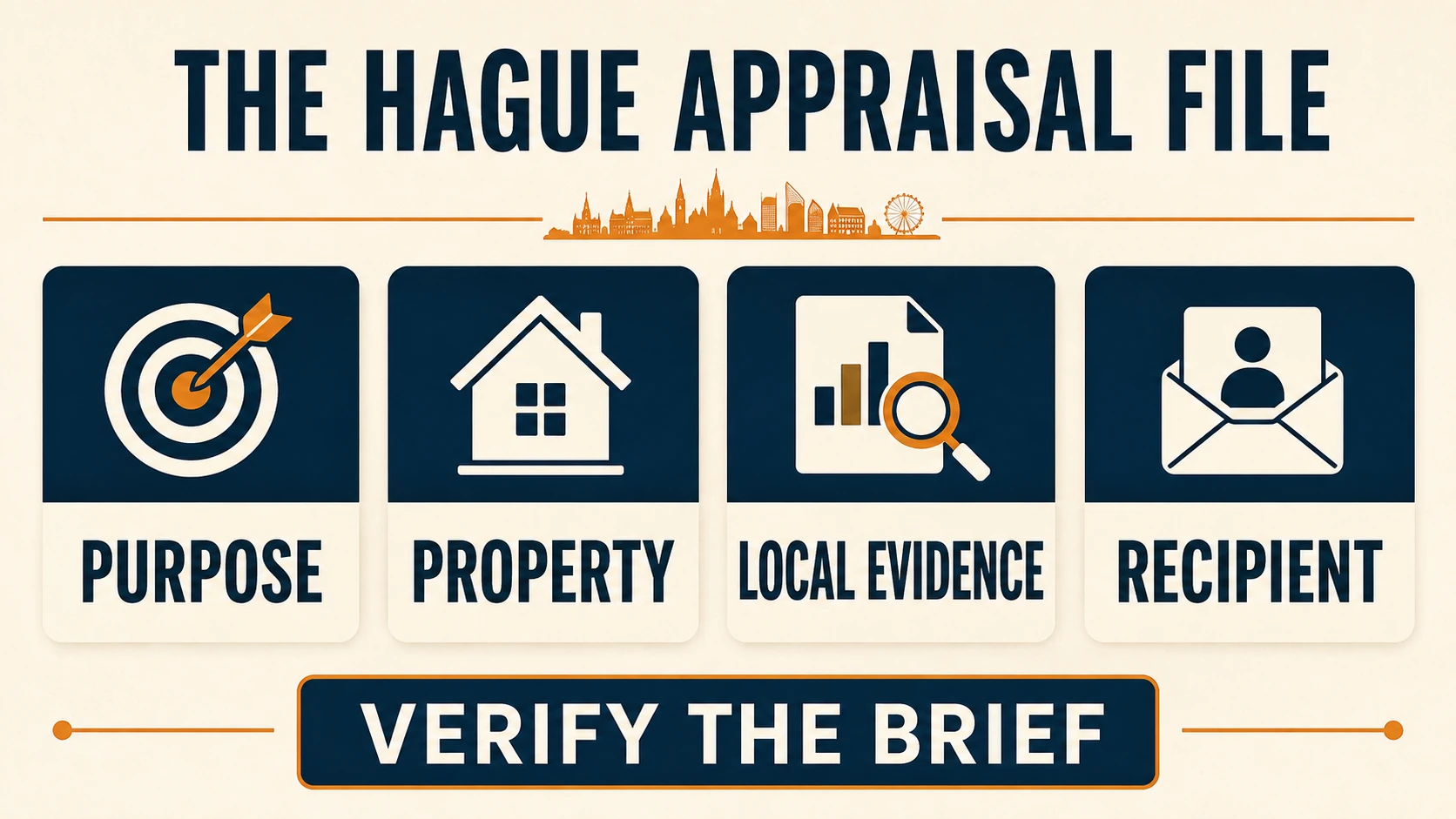
Quality model: the criteria that matter
| Criterion | What to verify | Strong signal | Warning sign |
|---|---|---|---|
| Qualification | Current identity and relevant registration | Public register match | Unverifiable badge |
| Experience | Similar property and purpose | Specific anonymised explanation | Generic city wording |
| Independence | Conflicts and role | Written conflict response | Desired outcome promised |
| Method | Value basis and evidence | Clear method explanation | One unsupported number |
| Local relevance | Hague property facts and records | Relevant examples and records | City name copied into text |
| Communication | Scope, timing and questions | Written milestones | No named contact process |
| Price | Inclusions and extras | Itemised scope | Headline fee only |
| Review | Review and limits | Assumptions and plausibility review | No explanation of limits |
Use the same criteria for every professional so price and familiarity do not dominate the decision.
Credentials, registration and standards
Ask for the professional identity, register and category relevant to the assignment.
What the credential does and does not establish
Registration can support an identity and professional-status check. It does not by itself establish local evidence, independence for this instruction, report acceptance, timing or suitability for a property with unusual rights.
Questions to ask
- Which registration and category apply to this assignment?
- Who performs the inspection and who reviews the work?
- Which value basis, date and report standard are proposed?
- What could make the report unsuitable for the named recipient?
Experience: how to verify relevant experience
Ask how often the professional handles the relevant property type and purpose in The Hague or its actual working area. Useful evidence is a specific anonymised example, a clear explanation of local property facts, a description of the records used and an honest statement of limits. Vague claims about knowing the city are weaker than an answer tied to the property and brief.
The assignment review process
Before the appointment
Purpose, recipient, value date, property identity, required records, conflicts, price and timing should be agreed. The scope should state what happens when a document is missing.
During the work
The professional should collect appropriate property and market evidence, record relevant rights and condition and distinguish inspected facts from assumptions. Local knowledge should be demonstrated through evidence, not only a postcode.
Before delivery
The report should be checked against the purpose and recipient. Property identity, method, evidence, assumptions, limitations and uncertainty should be visible, with a way to ask a bounded follow-up question.
Red flags and the next verification question
- A desired value is promised before the property facts are reviewed. Ask how independence is protected.
- A low fee excludes inspection or needed evidence. Ask for the complete scope and extras.
- The city name appears often but no Hague property factor is explained. Ask for a relevant anonymised example.
- A registration number is missing or cannot be matched. Ask for the exact public-register identity.
- The report standard is vague. Ask who must accept it and which fields are required.
- The professional cannot explain who performs and reviews the work. Ask for the review sequence.
- Reviews are identical or lack service detail. Ask for technical evidence rather than relying on praise.
Reviews and independent proof
A useful review can describe the service, situation, process and timing without exposing private details. Reviews can show communication experience, yet they cannot prove current registration, method, independence or suitability for a specific Hague property. Treat public praise as one context signal and retain the objective checks.
Questions to ask before hiring
- Are you registered for this type of valuation?
- Which Hague property types and purposes do you handle?
- Who performs the inspection and who reviews the report?
- Which value date and value basis will be used?
- What evidence and records do you need?
- What is included in the total price?
- What could cause extra work or delay?
- How are conflicts of interest handled?
- What does the recipient need to accept the report?
- What happens when a fact or document is missing?
Balanced provider evaluation framework
Score each professional only after evidence is recorded. A simple 0 to 5 note can organise the conversation, but it is not an objective ranking:
| Criterion | Evidence recorded | Mandatory? | Notes |
|---|---|---|---|
| Registration | Public identity and category | Yes where required | |
| Relevant experience | Property and purpose example | Depends on brief | |
| Method and evidence | Explained value basis and records | Yes | |
| Independence | Conflict response | Yes | |
| Scope and price | Inclusions and extras | Yes | |
| Communication | Milestones and question process | Useful | |
| Local relevance | Hague-specific property evidence | Depends on object |
Local and geographic quality signals
A Hague assignment should identify the actual property facts that matter: apartment rights, older urban construction, renovation, leases, land or use rights, condition and the evidence available for the relevant value date. These signals are more useful than a copied city name. Confirm that the professional’s working area and experience fit the object rather than assuming that one city label proves coverage.
Frequently asked questions
Does a Hague address prove local experience?
No. Ask how the professional’s experience relates to the property type, rights, value date and purpose. Relevant evidence matters more than a location claim alone.
Is a Rotterdam-focused information platform a Hague valuation provider?
The platform publishes general information with a Rotterdam focus and does not present a Hague office or provider directory in this information. A reader seeking a Hague assignment should verify a suitable professional independently.
Does a higher fee mean a better professional?
No. Price should be compared after scope, evidence, recipient and delivery are aligned. Ask what the extra cost changes.
Can a WOZ value answer every Hague valuation question?
No. The relevant value and date depend on the decision. Ask the tax adviser, lender or other recipient what is required and ask the professional how the value basis is defined.
What if the property has several owners?
State the ownership question and intended recipient before the assignment. A valuation supplies evidence; legal entitlement and settlement remain separate matters.
What if no professional can meet the deadline?
State the deadline and recipient and ask what responsible scope is possible. Do not remove necessary evidence merely to obtain a faster answer.
Trust checklist
- Purpose, recipient and value date are written down.
- Registration is matched in the relevant public register.
- Hague property and evidence experience is explained with a concrete property factor.
- Scope, price, timing, assumptions and limits are visible.
- Independence and review responsibilities are clear.
- No personal documents are sent through a public form.
Write the property type, purpose, recipient, value date, local evidence question, registration requirement and deadline before contacting a professional. Ask how the proposed scope fits those fields. Contact us with a general question; do not send passports, contracts, bank details or other personal documents through the public form.
Contact us about a Hague valuation brief