Common mistakes when requesting a property valuation
Avoid common property valuation request mistakes by naming the purpose, recipient, value date, property facts, evidence, deadline and delivery conditions.

Many valuation problems begin before the appointment. The request may omit the purpose, recipient, value date, property facts or the records that support the answer. A careful request makes those fields visible and gives the professional a fair chance to explain the right scope.
If you are preparing a Rotterdam valuation file, name the decision, recipient, property facts and valuation date before you compare evidence.
TL;DR: five request errors to remove
- Do not ask for a number without naming the decision it must support.
- Do not let a quote hide its recipient, date, inspection or exclusions.
- Do not mix the property value with mortgage, tax, settlement or legal calculations.
- Do not describe a complex property only by its street address.
- Do not treat a fast answer as equivalent to a formal report without confirming the purpose.
A request is ready when another professional can identify the object, decision, recipient, evidence and delivery conditions from one short brief.
Repair it by comparing inspection, evidence, report format, assumptions, delivery and follow-up.
The delivered file should make property identity, purpose, evidence, assumptions, method and limits visible.
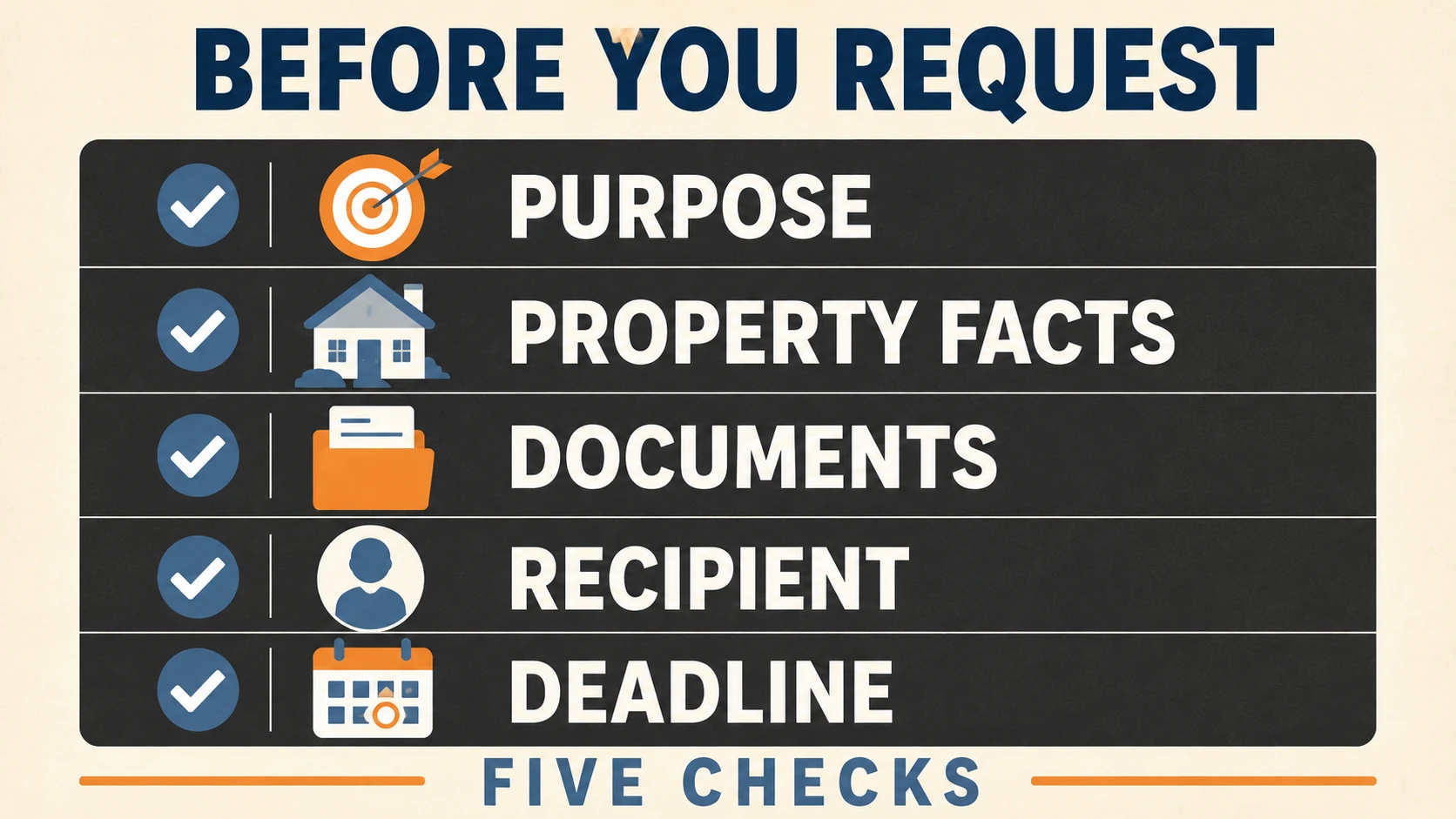
Before sending the request, put the decision, recipient, property facts, value date, evidence, deadline and missing records in one short brief.
Before you compare the report, align your purpose, recipient and evidence with NRVT residential valuation practice guidance.
For this assignment, keep the relevant property or file facts beside Kadaster sales-information fields before you rely on the conclusion.
When your file raises a related question, compare the facts with property valuation costs Rotterdam before you choose the report scope.
When your file raises a related question, compare the facts with what is a property valuation report before you choose the next step.
Before you compare the report, align your purpose, recipient and evidence with NRVT residential valuation practice guidance.
For this assignment, keep the relevant property or file facts beside Kadaster sales-information fields before you rely on the conclusion.
When your file raises a related question, compare the facts with property valuation costs Rotterdam before you choose the report scope.
When your file raises a related question, compare the facts with what is a property valuation report before you choose the next step.
Context that informs this decision
Property valuation costs in Rotterdam become meaningful only after those fields are aligned.
Property valuation report contents gives useful field names for that review.
If a field is uncertain, contact us about the valuation assignment with a general question and without personal documents.
If you are requesting a valuation, compare the documents, access arrangements and property facts with a property valuation in Maarheeze without mixing its address evidence into the Rotterdam file.
If the property question is still broad, a property valuer in Rotterdam can help you frame the local assignment fields before you compare quotes.
Who this helps
This preparation is for homeowners, buyers, sellers, landlords and advisers who are about to request a property valuation in Rotterdam. It is useful when a previous request produced an unclear quote, when several parties need the same evidence or when a deadline makes late clarification expensive.
What you need before you ask
Gather the facts without sending personal documents through a public form:
- The exact decision: mortgage, purchase, sale, tax, dispute, inheritance or orientation.
- The intended recipient and any required report standard.
- The property address, type, rights, use, floor area and known changes.
- The value date, inspection expectations and delivery deadline.
- Available ownership, lease, apartment, renovation and other relevant records.
Context: why the first request matters
A valuation is an opinion under stated assumptions and a defined purpose. The same property can need different evidence for a lender, a buyer, a tax question or a family discussion. The professional can explain value, method, evidence and uncertainty; the relevant lender, tax adviser, lawyer or family agreement decides the wider consequence.
Constraints to state up front
Tell the professional about occupancy, leases, apartment rights, recent works, known defects, land or use rights, multiple owners and any formal recipient. State what is known and what is missing. A missing document is a reason to ask about assumptions, not a reason to silently fill in a fact.
A five-step request sequence
1. Write the decision
Use one sentence that names the property and the decision. A plain version is: “We need a valuation of this home for a mortgage application to the named lender.” Keep a tax, legal, settlement or investment question separate when it needs another professional.
2. Name the recipient and standard
Ask who must accept the report and whether a register, format, inspection or lender condition applies. A report intended for personal orientation may not meet a formal recipient’s requirements.
3. Describe the property honestly
Include the type, rights, use, floor area, plot, apartment structure, leases, renovations and known restrictions. Do not use a city name as a substitute for object facts.
4. List documents and gaps
Name the records available and the records that are missing. Ask how the missing item will affect the evidence, timing or conclusion. Keep passports, bank details and confidential contracts out of a public contact form.
5. Confirm delivery and follow-up
Ask for the report format, value date, inspection date, delivery time, included explanation, correction process and any extra-cost triggers. This makes the quote and the final work comparable.
Scenarios that change the request
A purchase with a financing deadline
The recipient and deadline have priority. Ask the lender or mortgage adviser what the file must contain, then give the professional enough time to confirm whether the assignment fits.
An apartment with VvE records
The apartment value may depend on rights, common parts, maintenance plans and financial records. State which VvE documents exist and which are missing instead of describing the apartment as an ordinary house.
A property after renovation
Separate completed work from planned work and provide approvals or invoices where relevant. Ask how unfinished or undocumented work will be treated in the valuation evidence.
Common mistakes and the repair for each one
Mistake 1: asking for a current value without a purpose
Repair it by naming the decision and recipient. The value date and evidence can then be discussed in the right context.
Mistake 2: comparing only the headline fee
Mistake 3: promising a desired number
Repair it by asking for an independent opinion under stated evidence and assumptions. A requested outcome is not a substitute for a defensible method.
Mistake 4: hiding ownership or occupancy
Repair it by stating shares, leases, use and restrictions at the start. These facts can change the relevant question.
Mistake 5: using one report for every decision
Repair it by asking the lender, tax adviser, lawyer or family parties whether the same purpose, recipient and date apply.
After the request
Save the final brief, the agreed scope, the records supplied, the inspection and value dates, the quote, the report and any written clarification. If the property changes or the recipient changes, ask whether the original assignment still answers the new decision.
Frequently asked questions
What is the biggest mistake in a valuation request?
Leaving the purpose and recipient vague. Without those fields, two professionals can answer different questions while using the same address.
Should I send all documents with the first message?
Send a short, non-sensitive summary first and ask which records are needed. Do not send passports, bank details or confidential contracts through a public form.
Can I request a valuation before the property is inspected?
You can ask about availability and scope, but the professional should explain the inspection, evidence and assumptions that apply. A current date does not automatically answer a historical value question.
What if I have a short deadline?
State the deadline and recipient immediately. The professional can say whether the requested work can be completed responsibly within that time.
Can an estate agent choose the scope for me?
An estate agent may provide context, but the assignment should be agreed with the professional who performs the valuation and the recipient who needs it. Tax, legal and lender questions may require separate advice.
What if the quote is unclear?
Ask for purpose, recipient, dates, inspection, documents, report format, assumptions, exclusions, delivery and extra-cost triggers in writing. If those answers remain vague, the quote is difficult to compare.
A final request check
Quality checklist
- The request names one main decision.
- The recipient and value date are explicit.
- Property rights, use and known changes are included.
- Missing records and assumptions are acknowledged.
- Delivery, timing and follow-up are defined.
- Personal and confidential documents stay out of the public form.
Write one main decision, the intended recipient, value date, property rights, use, known changes, available records and deadline. Ask which documents are actually needed before sharing anything sensitive. Contact us with a general scope question; do not send passports, contracts, bank details or other personal documents through the public form.
Contact us about a valuation request