Registered Property Valuer in Rotterdam: How to Check the Register
Learn what a registered property valuer means in the Netherlands, how to check the NRVT record and how to test report fit for a Rotterdam property.

A registered property valuer in Rotterdam is a person whose professional registration can be checked in the Dutch NRVT system. Search the person’s name, confirm the relevant chamber and then test the assignment, independence, evidence and report recipient. A registration gives you a useful professional record. It does not settle every question about the report you need.
If you are comparing professionals, test registration, independence, assignment fit and evidence against the decision your report needs to support.
TL;DR
Use this order when you compare a registered property valuer:
- Search the person’s name in the public NRVT register.
- Check that the chamber and residential assignment fit the property.
- Confirm who needs the report and which form that party accepts.
- Ask about independence, earlier involvement and who performs the work.
- Compare evidence, local knowledge, scope and cost after those checks.
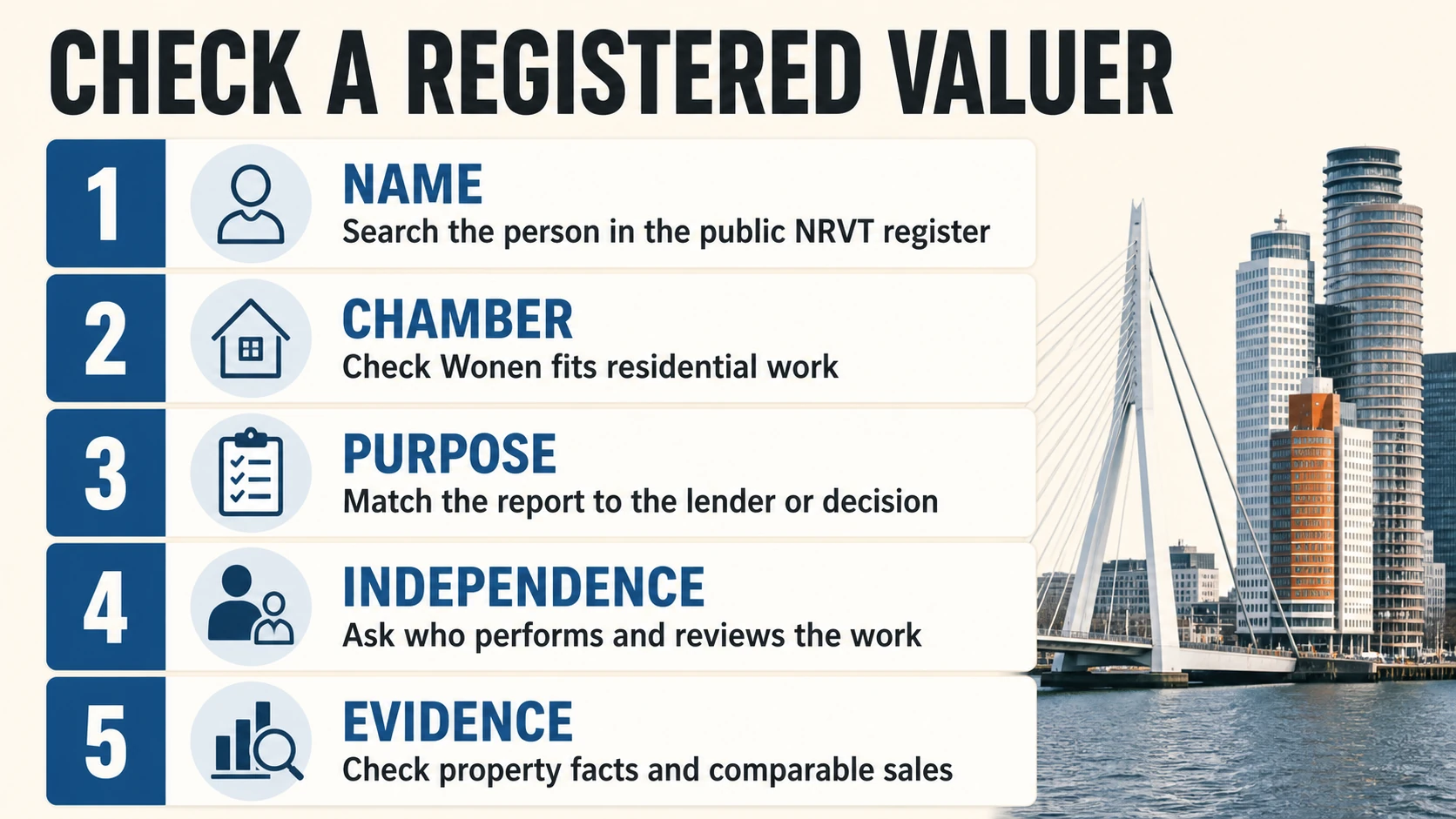
Before you compare the report, align your purpose, recipient and evidence with NRVT residential valuation practice guidance.
For this assignment, keep the relevant property or file facts beside NRVT residential valuation practice guidance before you rely on the conclusion.
When your file raises a related question, compare the facts with how to choose a reliable property valuer before you choose the report scope.
When your file raises a related question, compare the facts with what does a property valuer do Rotterdam before you choose the next step.
Before you compare the report, align your purpose, recipient and evidence with NRVT residential valuation practice guidance.
For this assignment, keep the relevant property or file facts beside NRVT residential valuation practice guidance before you rely on the conclusion.
When your file raises a related question, compare the facts with how to choose a reliable property valuer before you choose the report scope.
When your file raises a related question, compare the facts with what does a property valuer do Rotterdam before you choose the next step.
Context that informs this decision
A mortgage file also has three separate questions: reliable property valuer selection, mortgage valuation and mortgage valuation requirements.
Inspection, evidence review and report reasoning define a property valuer’s role.
For a local question about a register entry, assignment or report recipient, contact Taxateur Rotterdam Pro.
When checking registration, keep the person’s status separate from a property valuation in Best; location evidence cannot prove professional registration.
An unclear assignment needs a purpose, recipient and property facts before property valuer in Rotterdam can be compared.
The name in the public NRVT Register-Taxateur record should match the person who will perform the valuation.
The report brief must match valuation report contents, including purpose and date.
When the recipient mentions NWWI, NWWI report review requirements concern the submitted report rather than professional registration.
Why a register check matters
The decision risk
A report can be professionally prepared and still miss the needs of its recipient. A lender, adviser, authority or private client may ask for a specific purpose, valuation date, inspection or report review. A mismatch can create delay, a second assignment or a report that cannot support the decision.
Once the question is clear, the public register becomes one part of a wider check.
What registration adds
The NRVT register is a public place to check a person-level professional status. NRVT explains that registered valuers use the title Register-Taxateur, often shortened to RT, and are connected to a professional framework. That gives you a name and status to verify rather than relying only on a profile page.
Registration does not tell you whether the valuer has handled your exact apartment right, leasehold position, extension, mixed use or report date. Those details belong in the assignment discussion.
Four checks before you instruct someone
Use four required checks before comparing softer signals such as response time or presentation.
1. Search the person, not only the business
If a company appears on an offer, ask which individual is responsible for the report.
Save the date of your check and the exact name or record reference you used. A register can change, and a company name alone may not identify the person who holds the status.
2. Check the chamber and assignment
Ask which NRVT chamber covers the work. A residential valuation belongs in a different professional context from a valuation of commercial property or a WOZ-related assignment. Confirm that the valuer regularly handles homes and the property category in front of you.
Ask what the report must answer, who receives it and what documents or inspection are included. This turns a general request for a valuation into a defined assignment.
3. Confirm independence
Ask about earlier involvement in the purchase, sale, brokerage, financing, building inspection or renovation. Ask who performs the inspection, who reviews the file and whether the valuer has a relationship with the owner, buyer, seller or lender.
NRVT’s professional rules address objectivity and independence. A valuer should identify a threat, take suitable measures or decline the work when the concern cannot be resolved. You do not need to interpret the rules alone. You do need a clear answer before the assignment starts.
4. Match the report to the recipient
Ask the lender, adviser or other recipient which report form and report review it accepts.
An NHG physical valuation has conditions about independence, accepted report review and report age in the stated context.
Registration, title and standards
What “registered property valuer” means here
The Dutch professional term Register-Taxateur refers to a person registered with NRVT. The register is different from a marketing phrase such as “experienced valuer”. If a provider uses the word registered, ask for the person’s full name and the record you can check.
What a professional standard can cover
NRVT residential guidance addresses competence, local familiarity and the standards used for residential valuation work. A good conversation connects those points to the home in Rotterdam: its property type, legal position, condition, improvements and comparable evidence.
The record is a starting point. Read the offer for the stated value date, inspection, research, report format, report review and delivery point.
Registered versus validated
Registration concerns the professional.
NWWI report review concerns a submitted valuation report and its review under NWWI’s process.
The two checks can appear in the same mortgage file, yet they answer different questions.
Relevant Rotterdam experience
Property facts that deserve a direct question
Rotterdam homes can bring together apartment rights, leasehold, foundation information, extensions, energy work, protected streetscapes and different construction periods. These are prompts for a conversation, not assumptions about every address.
Ask how the valuer will handle:
- the deed of division and VvE information for an apartment;
- leasehold terms, if they apply;
- an extension, converted attic or unfinished work;
- foundation or maintenance information already in your file;
- a property near water, infrastructure or a protected streetscape;
- a value date that differs from the inspection date.
Evidence matters more than a city label
Local knowledge is useful when it changes the evidence selected and the limits explained. Ask which comparable sales, property characteristics and local market signals will be considered. A statement that someone “knows Rotterdam” needs a property-specific follow-up question.
How the work should be checked
Before the visit
Give the valuer the purpose, recipient, address, ownership position and known changes to the home. Ask which plans, permits, VvE documents, leasehold papers and renovation records are needed. Agree on the value date and delivery point in writing.
During the inspection
Explain any unfinished, repaired or planned work. Point out facts that may not be obvious from a quick viewing, such as a changed layout, shared maintenance issue or restriction on use. The valuer should be able to ask for evidence rather than infer an important fact from appearance alone.
Before delivery
Read the report for the correct address, purpose, date, property description, assumptions, limitations and supporting evidence. If the recipient has a required form or report review, check that it is present before sending the report onward.
Warning signs and useful follow-up questions
Treat these signals as prompts for clarification:
- The person cannot be identified in the register. Ask for the exact registered name.
- The offer describes a company but no responsible valuer. Ask who signs and who inspects.
- The recipient is missing from the brief. Ask which party will rely on the report.
- Independence is answered vaguely. Ask about previous work for the parties involved.
- The price may exclude inspection or report work. Ask what inspection, research, report review and revisions are included.
- Important property facts are waved away. Ask which documents support the conclusion.
Questions to ask before hiring
Use this short list in an enquiry:
- Which individual will perform and sign the report?
- How can I find that person in the NRVT register?
- Which chamber and residential experience apply to this property?
- Which report purpose, recipient and value date are in scope?
- Is an inspection required, and what does it cover?
- Is NWWI or another report review accepted by the recipient?
- How will apartment rights, leasehold or renovation facts be checked?
- What is included in the fee and what could create extra work?
A balanced way to compare providers
First mark the mandatory checks as yes, no or unclear: person-level registration, assignment fit, independence and recipient conditions. Do not compensate for an unclear mandatory condition with a fast reply or polished website.
Then compare the supporting evidence: relevant property experience, clarity of scope, file requests, communication, timing and cost. Write one sentence explaining the evidence behind each choice. That record is useful if the assignment changes later.
Rotterdam-specific signals
Apartments and VvE information
Ask whether the assignment needs the deed of division, VvE budget, reserve position, planned work or known disputes. The relevant documents depend on the home and the report purpose.
Leasehold and land position
Ask how the leasehold terms, payment position, end date or buyout information will be represented. If the property has no leasehold, this check can be closed quickly.
Extensions and condition
An extension, converted roof space or unfinished renovation deserves clear plans, permits and current-state information. Ask how the current value and any planned result will be separated in the report.
FAQ
Is a registered property valuer the same as a certified valuer?
The labels can overlap in everyday searches, yet they do not answer the same question automatically. Check the person’s NRVT status, the intended chamber and the report conditions instead of relying on one word in a profile.
Can I search a company instead of a person?
Start with the person who will perform or sign the valuation. A company name can help you find the provider, while the professional record belongs to the individual.
Does NRVT registration guarantee lender acceptance?
No. Registration is one professional check. The lender or other recipient can set its own requirements for report form, report review, date, inspection and property details.
Does local Rotterdam experience require an office in Rotterdam?
No particular office address proves competence. Ask how the valuer demonstrates knowledge of the location and property category and how that knowledge will affect the evidence.
Should I choose the lowest fee?
Compare like with like first. A lower amount may exclude a visit, research, report review or a required revision. A higher amount may include work that your recipient does not need.
What if I discover a problem after the assignment starts?
Raise it as soon as you see it and ask how it affects scope, evidence, timing or cost. If the recipient’s condition changes, confirm the new brief in writing.
How recent should the register check be?
Check close to the time you instruct the valuer and keep the date of the check in your file. Report-age rules belong to the recipient and purpose, so confirm those separately.
Where can I ask about a report condition?
Contact us with the property type, intended recipient and question. We can help you identify which part of the brief needs clarification; the receiving party remains responsible for its acceptance decision.
Related questions
Provider choice rests on credentials, independence and communication.
Before you instruct someone
You should be able to answer four questions in writing:
- Which person is registered?
- Which chamber and assignment fit the home?
- Which recipient and report conditions apply?
- Which evidence will support the conclusion?
If one answer is missing, pause the instruction and ask a focused question. Taxateur Rotterdam Pro provides general information about valuation and reports. The valuer and the report recipient remain responsible for professional work and acceptance.
The practical next step is simple: save the register result, send the four questions with your property brief and ask for a written reply.
Copy the person's register name and chamber, then ask the report recipient whether the assignment, property type and report form fit your decision. If one of those checks is unclear, contact us with the question and the purpose of the report.
Ask about checking a registered valuer →