What Does a Property Valuer in Rotterdam Do? Definition and Role
A clear definition of what a property valuer in Rotterdam investigates, records and explains for a stated purpose and valuation date.

A property valuer in Rotterdam investigates a home and its relevant rights, condition, location and market evidence. The valuer then gives a reasoned opinion of value for a stated date and purpose and records the work in a report for the named recipient.
TL;DR
The useful order is to define the purpose, recipient, property, valuation date, evidence and limits of the report.
For a clear valuation question, name the decision, recipient, property facts and valuation date before you discuss the report.
Before you compare the report, align your purpose, recipient and evidence with NRVT residential valuation practice guidance.
For this assignment, keep the relevant property or file facts beside NRVT residential valuation practice guidance before you rely on the conclusion.
When your file raises a related question, compare the facts with property valuer The Hague before you choose the report scope.
When your file raises a related question, compare the facts with valuation for WOZ objection Rotterdam before you choose the next step.
Before you compare the report, align your purpose, recipient and evidence with NRVT residential valuation practice guidance.
For this assignment, keep the relevant property or file facts beside NRVT residential valuation practice guidance before you rely on the conclusion.
When your file raises a related question, compare the facts with property valuer The Hague before you choose the report scope.
When your file raises a related question, compare the facts with valuation for WOZ objection Rotterdam before you choose the next step.
Context that informs this decision
The NRVT residential inspection standards describe the usual personal inspection of a residential property and the need to support the report with relevant information, assumptions and reasoning.
The same assignment fields matter when comparing a property valuer in The Hague, because local fit still depends on property evidence.
A Rotterdam WOZ objection has a different purpose, and valuation for a Rotterdam WOZ objection identifies the evidence relevant to that decision.
- Value indication: an early estimate that may help with orientation. A formal report and an early indication serve different decisions; formal valuation versus a value indication distinguishes the two.
Provider choice depends on property valuer questions in Rotterdam about documents, timing and report conditions.
When explaining a valuer’s work to a client, keep purpose and property facts visible in a property valuation in Oirschot rather than treating the role as a generic label.
Name the provider question in property valuer in Rotterdam and compare the result with valuation report contents.
If the recipient or purpose remains unclear, send us the assignment details.
The public NRVT Register-Taxateur record lists the fields needed for a registration comparison.
Definition at a glance
The role combines inspection, research and explanation. A valuer looks at the physical home, the information that affects its use or ownership, the surrounding setting and suitable market evidence. The conclusion belongs to a defined assignment. The purpose may involve a mortgage, sale, division, inheritance or another decision.
A limited inspection can occur in an exceptional setting when the assignment and report state that scope.
Why the role matters
A price seen in a listing, an online estimate and a professional valuation answer different questions. The valuer’s job is to connect the question to a value concept, a valuation date, property facts and evidence that can be explained to the receiving party.
That chain helps a reader understand why local familiarity is useful. Rotterdam includes apartments with shared-building information, older upper-floor homes, terraces, new construction and properties affected by water, traffic or leasehold. The relevant issue is the way those facts affect the assignment and comparison evidence for one address.
The municipality’s WOZ value is a public-law valuation for municipal purposes.
Rijksoverheid explains how owners can review the value and the information behind it through the WOZ-waardeloket.
A private valuation has its own assignment and valuation date.
-
Property valuation report: the documented output of a defined valuation assignment. It records the purpose, evidence, valuation date and conclusion for the receiving party.
-
Register-Taxateur: the NRVT professional title and public-register context described in the definition.
-
report review: an additional report check that can be required by a receiving party. The receiving party’s current conditions remain decisive.
-
WOZ value: the municipal valuation used for public-law purposes, with information available through official Dutch channels.
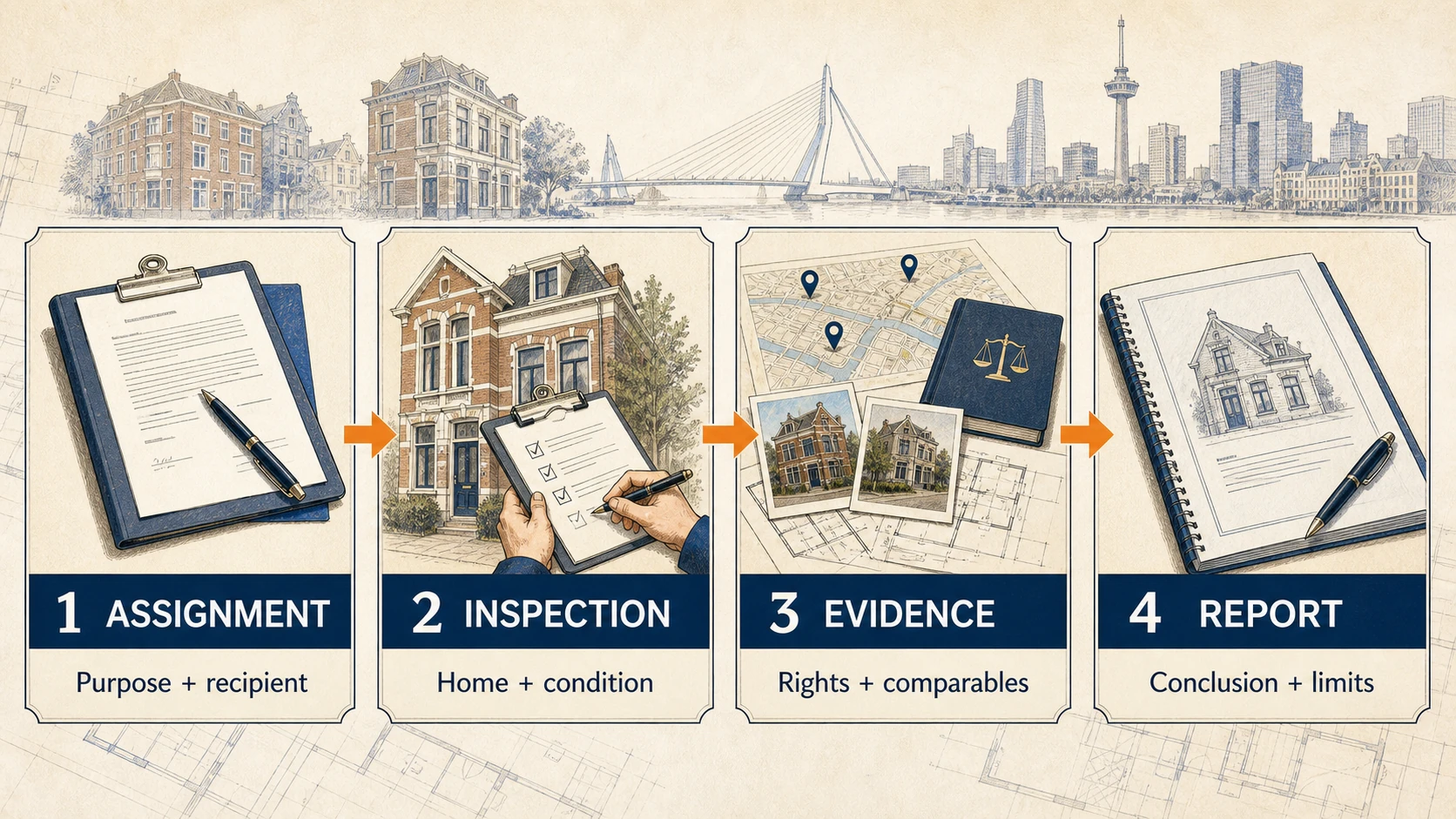
What the work includes
1. Clarify the assignment
The valuer needs to know the purpose, intended recipient, property address, type of home and valuation date. A lender, mediator, executor, owner or buyer can ask a different question about the same property. The report form and evidence should fit that purpose.
2. Inspect the home and surroundings
The inspection gives the valuer first-hand information about layout, condition, finish, access, surroundings and visible features. The valuer can then compare supplied documents with what is observed. If the assignment uses a limited inspection, the scope belongs in the report and the reader should understand the resulting limits.
3. Research rights and property information
A residential valuation can involve ownership, cadastral details, apartment rights, owners association information, leasehold, permits, extensions, energy improvements, maintenance and known defects. The relevant points depend on the home and the purpose of the report.
4. Select and interpret evidence
Comparable sales are useful when their property type, size, condition, location and date make sense beside the subject property. The valuer weighs similarities and differences rather than treating a single sale or listing as a complete answer. Rotterdam context becomes meaningful through the features that affect this comparison.
5. Explain the value conclusion
The report records the valuation date, assumptions, information used, limits and reasoning. NRVT’s public explanation says the valuation date precedes the report date, so these dates should be kept distinct when a reader checks the file.
Attributes and variations
The same professional role can look different because six variables change the work:
- Purpose: mortgage, sale, division, inheritance, tax discussion or early planning can create different questions.
- Property: apartment rights, leasehold, construction type, condition and unusual use affect the research.
- Inspection: a physical inspection gives first-hand observations; another accepted form can have a different scope.
- Evidence: relevant sales and property information need to support the stated conclusion.
- Recipient: a lender, authority, adviser or private client may apply different acceptance conditions.
- Date: value, inspection and report dates describe different moments and should be labelled clearly.
The title Register-Taxateur, often shortened to RT, refers to a registered professional in the NRVT context.
Registration supports a professional check; it does not decide whether a particular report meets a recipient’s current conditions.
Examples and common misunderstandings
Mortgage question
A buyer needs a report for a lender. The main question is the lender’s current acceptance condition, together with the required report form, report review and date. NHG’s requirements for a physical valuation report contain a six-month condition in that stated setting. The number belongs to that context and should be checked before commissioning a report.
Sale or division question
An owner, mediator or executor may need an opinion that explains the property and evidence at an agreed date. The intended reader and decision shape the assignment. A mortgage report may not answer every question in a family division or negotiation.
WOZ question
Common misunderstandings
- A city name by itself does not show that the evidence fits an address.
- A registered title does not remove the need to check purpose, recipient and scope.
- A listing price is an asking position, while a valuation is a reasoned opinion for a stated assignment.
- The WOZ value and a private valuation can use different purposes, dates and methods.
Related terms and comparisons
When you encounter a valuer’s role
You will usually meet this role when a form, lender, adviser, mediator or personal decision asks for a property value. Prepare a short brief before contacting a professional:
- State the decision the value must support.
- Name the receiving party and ask what it accepts.
- Add the address, property type and relevant date.
- List apartment, leasehold, renovation, energy, maintenance or foundation information you already have.
- Ask what the inspection, report, report review, timing and fee include.
Frequently asked questions
Does a property valuer set the sale price?
A valuation gives an opinion of value for its assignment and date. An owner and buyer can agree a transaction price based on their own circumstances. A listing price serves a marketing decision and does not replace the valuation reasoning in a report.
Does every valuation require a physical visit?
The assignment and recipient decide the accepted form. NRVT guidance describes personal inspection as the usual residential practice and records limited inspection as an exceptional, stated scope. Mortgage conditions can also allow or require particular forms.
Is the inspection date the valuation date?
They describe different events. The inspection records observations at the visit. The valuation date is the date to which the value opinion applies, and the report date records when the document is issued.
How long is a valuation report valid?
There is no single age rule for every use. The six-month condition belongs to the stated NHG physical-report context. Ask the receiving party for its current requirement before ordering a report.
Is a WOZ value the same as a private valuation?
They serve different purposes and can use different dates and information. Start with the municipal explanation for a WOZ question and the assignment brief for a private valuation.
Can an online estimate replace the valuer’s work?
An online estimate can help with early planning. A recipient that needs a defined report will normally specify its own evidence and acceptance conditions. The intended decision should guide the choice.
Keep this definition current
Check the current NRVT guidance, the receiving party’s conditions and the relevant NHG or municipal information before relying on a time-sensitive detail. Review the valuation date, inspection date and report date together. Recheck the public register when registration matters to the assignment.
Next steps
Write the purpose, recipient, address, property type and date in one short brief.
The role connects purpose, inspection, property rights, market evidence, valuation date and the report recipient. If you have a question about one part of that chain, contact us.
Ask about the valuer's role →