Valuation or value indication: which one fits your question?
Compare a formal valuation with a value indication by purpose, evidence, recipient, report format and next decision.

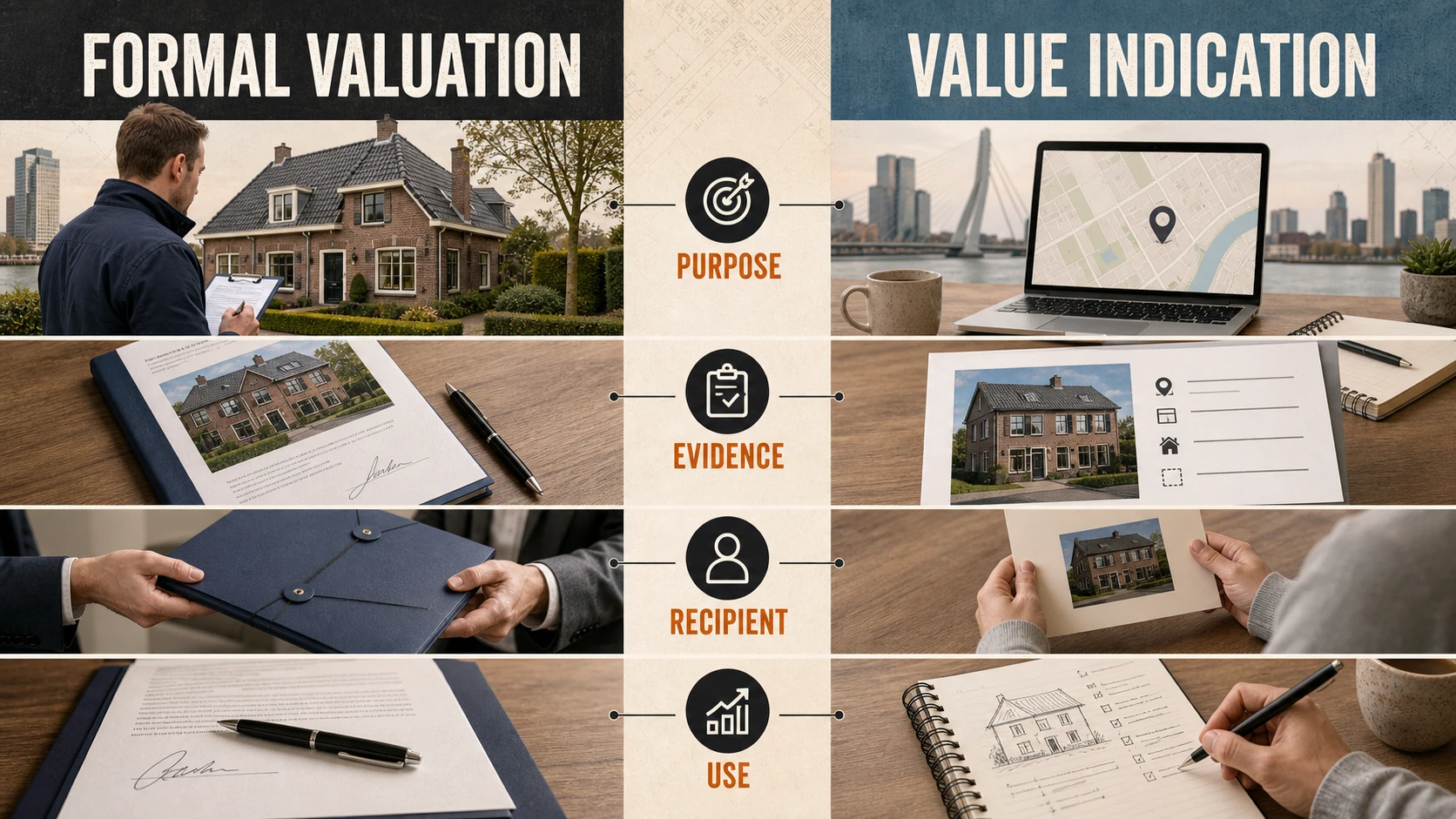
A formal valuation and a value indication answer different levels of need. Choose by asking who will use the result, which date matters, what evidence must be checked and whether a recipient requires a specific report. A value indication can help with early planning. A formal valuation suits a defined assignment with documented reasoning when a lender, authority or adviser needs to assess it.
For a Rotterdam housing or valuation question, put the purpose, recipient, property and relevant date in the brief before you request work.
TL;DR
Use a formal valuation when a named recipient needs a report that follows stated professional or lending conditions. Use a value indication when you need an early estimate to frame a conversation or decide what to investigate next. The label alone does not settle the choice. Confirm the purpose and acceptance rules before you order either service.
This is the practical checkpoint.
Ask the lender, adviser or authority before spending money.
The right next step may be a conversation with the recipient, a document check or a formal assignment.
Before you compare the report, align your purpose, recipient and evidence with NHG valuation requirements.
For this assignment, keep the relevant property or file facts beside NHG valuation requirements before you rely on the conclusion.
When your file raises a related question, compare the facts with home valuation Rotterdam steps before you choose the report scope.
When your file raises a related question, compare the facts with property valuer in Rotterdam before you choose the next step.
Before you compare the report, align your purpose, recipient and evidence with NHG valuation requirements.
For this assignment, keep the relevant property or file facts beside NHG valuation requirements before you rely on the conclusion.
When your file raises a related question, compare the facts with home valuation Rotterdam steps before you choose the report scope.
When your file raises a related question, compare the facts with property valuer in Rotterdam before you choose the next step.
Context that informs this decision
Different valuation forms serve different lending situations under NHG residential valuation rules.
Purpose, recipient and property facts belong in home valuation preparation in Rotterdam before a decision on scope.
When choosing between an indication and a formal report, compare the report review requirement with an NWWI valuation in Eindhoven before deciding which document the lender needs.
Provider questions belong to property valuer in Rotterdam, while lender-related questions belong to mortgage valuation for the next conversation.
Before comparing an indication with a formal report, verify that its purpose, date, evidence and assumptions are stated in the report’s valuation report contents.
At-a-glance comparison
| Question | Formal valuation | Value indication |
|---|---|---|
| What question does it answer? | A defined value assignment | An early estimate or orientation |
| What supports the result? | Inspection or agreed method, documents, sales and written reasoning | Available property data, sales signals or a model estimate |
| Who may use it? | A lender, authority, adviser or parties to an agreement | An owner, buyer or seller planning a next step |
| What should you check? | Purpose, date, assumptions, evidence and acceptance | Data coverage, date, limits and intended use |
Option A: formal valuation
A formal valuation begins with an assignment. The valuer records the purpose, value concept, valuation date, property rights and level of inspection. The report then sets out the property facts, assumptions, market evidence and conclusion.
This format can matter for a mortgage, division, inheritance or dispute. NHG states that a physical valuation report in its lending context must be made independently and validated by an accepted report review institute. NHG also states that such a report may not be older than six months counted from the valuation reference date. Conditions can change, so check the current rule with the lender or NHG before relying on it.
Strengths include a clear recipient, a defined date and a reasoned file. Limits include cost, preparation time and the fact that the conclusion remains an opinion based on information available at the assignment date.
Option B: value indication
A value indication gives an early sense of a possible value. It may use recent sales, public property data, a model or a short consultation. The exact method varies, so ask what information was used and whether anyone inspected the home.
This can be useful before a sale conversation, renovation decision or first mortgage discussion. It helps you form a question and spot missing facts. Its limits matter when the recipient needs a formal report, when the property has unusual rights or when the date must be defended.
An online figure can move when the database changes. It may miss a leasehold clause, an apartment building decision, a permit or a condition issue. Treat the result as an orientation point until its method and intended use are clear.
Four questions that settle the choice
1. Who will use the result?
Ask the future reader first. A lender or authority may request a specified report. An owner making an early plan may need less formal detail.
2. Which date matters?
A current indication may be of little help when the assignment asks for a value on an earlier date. State the date at the beginning.
3. What facts can change the result?
Apartment rights, ground rights, renovation, foundation information, condition and unusual use can all affect the analysis. Tell the provider what you know.
4. Can the recipient accept it?
A useful challenge to the quick estimate
Public sales data can answer part of the question, so a formal valuation may feel unnecessary. That logic works for early orientation when the facts are ordinary and no third party needs a report. It weakens when the assignment has a fixed date, unusual rights, a mortgage condition or a dispute about evidence.
FAQ
Is a value indication always cheaper?
Often the work is lighter, yet prices and inclusions vary. Ask what research, inspection and explanation are included before comparing fees.
Can a bank accept an online value indication?
Acceptance depends on the bank and the lending product. Ask the lender or adviser before relying on an online figure.
Is a formal valuation always more accurate?
It uses a defined assignment and documented reasoning, which can make it more suitable for a formal decision. The result still depends on the facts, evidence and valuation date.
Should I start with an indication before ordering a valuation?
That can help with early planning. If the recipient already asked for a formal report, check its conditions first so you do not buy work that cannot answer the final question.
Next step
Write down the purpose, recipient and date.
A formal valuation and a value indication can serve different purposes, recipients and evidence standards. If you are unsure which question you need to ask, contact us.
Ask about valuation types →