Why does your bank request a valuation report?
Understand why a Dutch mortgage lender asks for a valuation report, what it checks and which questions to ask before ordering one in Rotterdam.

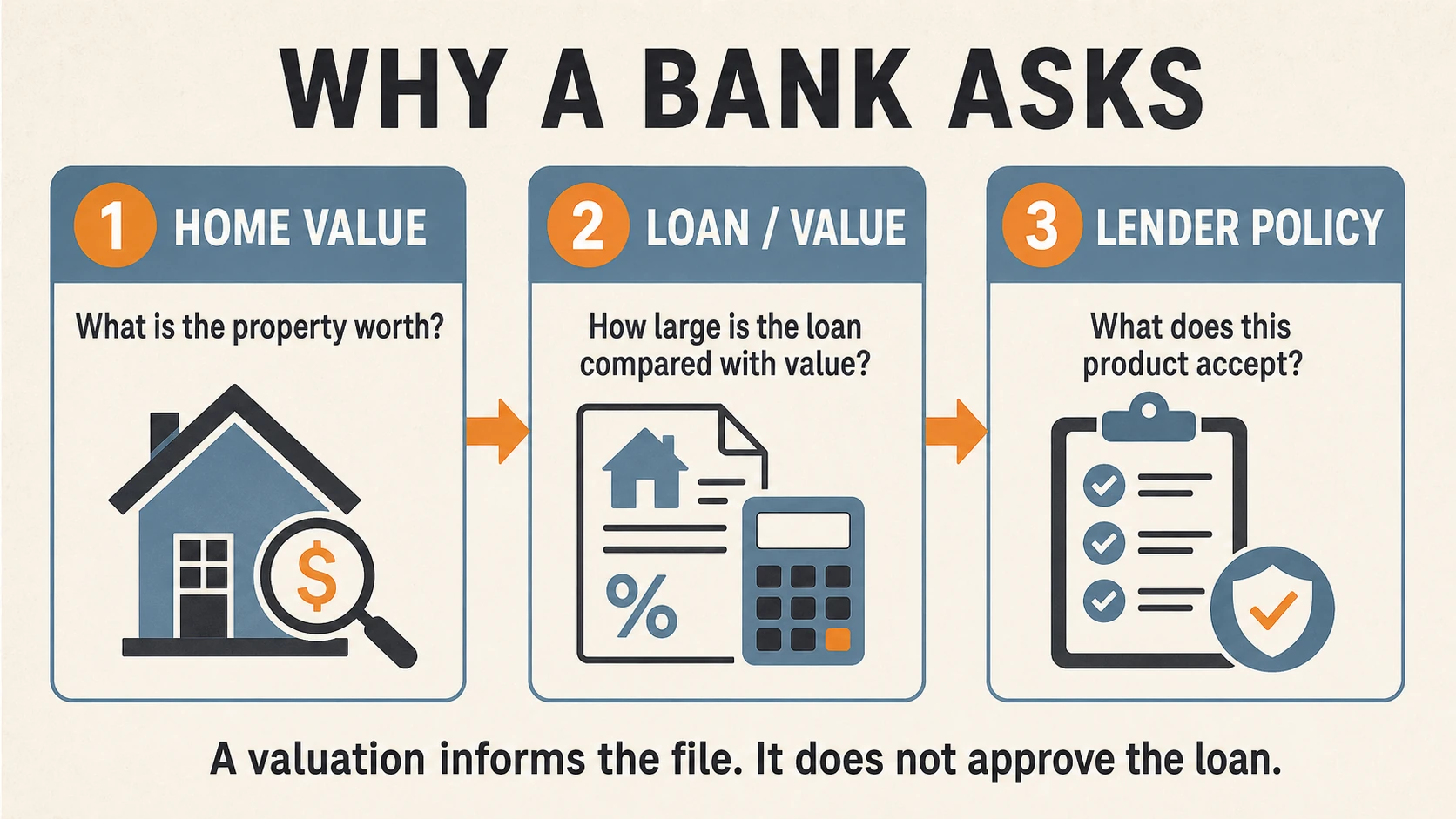
A bank requests a valuation report because the property is part of the mortgage security. The report gives the lender evidence about the home’s value and relevant property facts. The bank still assesses your income, debts, documents and product conditions separately. A report informs the file; it does not approve the loan.
For a lender-facing file, confirm the accepted report form, report review, valuation date and delivery deadline before you book a valuation.
TL;DR: three checks sit behind the request
Most lender questions can be organised into three separate checks:
- Home value: what is the property worth for the stated valuation date and purpose?
- Loan compared with value: how does the proposed mortgage relate to the value that the lender accepts?
- Lender policy: does this report form, date, report review and property file meet the product’s current conditions?
The government explains that borrowing capacity is based on income and the home’s value, with a general maximum of 100% of the home’s value under the applicable rules. The AFM also describes the loan-to-value relationship as part of responsible mortgage lending. Those rules explain why a lender needs reliable value evidence, but they do not turn a valuation into a lending decision.
A new provider may reassess the current property value as well as current income.
The AFM notes that a lender can ask for a valuation report in an oversluit situation, while an alternative such as a WOZ value may sometimes be accepted.
Ask for the recipient, purpose, accepted form, valuation date, report review and required documents in writing.
Before you compare the report, align your purpose, recipient and evidence with official valuation guidance.
For this assignment, keep the relevant property or file facts beside official valuation guidance before you rely on the conclusion.
When your file raises a related question, compare the facts with valuation when refinancing mortgage before you choose the report scope.
When your file raises a related question, compare the facts with what is a property valuation report before you choose the next step.
Before you compare the report, align your purpose, recipient and evidence with official valuation guidance.
For this assignment, keep the relevant property or file facts beside official valuation guidance before you rely on the conclusion.
When your file raises a related question, compare the facts with valuation when refinancing mortgage before you choose the report scope.
When your file raises a related question, compare the facts with what is a property valuation report before you choose the next step.
Context that informs this decision
refinancing valuation questions identify what to confirm.
valuation report contents define the document, while mortgage valuation connects preparation and evidence to the lender’s purpose.
You can also contact us with the lender’s wording and your question so the issue is clear before you order.
If your bank asks for a valuation, keep the address and value question together, as in a property valuation in Geldrop, without substituting another property’s evidence.
Turn that acceptance into questions about form, recipient, date and deadline through mortgage valuation requirements.
Who needs this explanation?
This explanation is for:
- buyers who have been asked to arrange a valuation after an offer;
- homeowners changing mortgage provider or reviewing a mortgage increase;
- applicants who are unsure whether a model result, hybrid valuation or physical report will be accepted;
- advisers and buyers who want a focused list of questions before commissioning a report.
It is not a borrowing-capacity calculator and it is not a promise that a lender will accept a particular value.
Why is the property value relevant to the bank?
A mortgage is secured against the home. If the lender accepts a value that is not supported by the property facts, its view of the security can be wrong. A valuation report gives the lender a structured assessment from an independent professional or an accepted alternative, depending on the file.
That is why a lender may ask for details such as the address, ownership form, floor area, condition, permits, leasehold or apartment rights, completed improvements and comparable market evidence. The report is directed at a particular purpose and value date. It is not a timeless certificate of what the home will sell for later.
The bank also looks beyond the property. Income, existing debts, employment, the mortgage product and the documents supporting the application can affect the decision. If those checks do not work, a strong property value does not fix the application.
What does a valuation report add to the mortgage file?
A value for a stated purpose and date
The report records the purpose and the valuation date. A purchase file, refinancing file and improvement file can ask different questions. Before ordering, ask the recipient whether its instruction requires a particular date or wording.
Property facts that a model may not know
The valuer considers relevant physical and legal features. Examples include layout, maintenance, extensions, permits, apartment rights, leasehold arrangements and visible defects. Tell the valuer about changes rather than assuming that a listing or older document contains the complete file.
Evidence behind the conclusion
Comparable properties and other market evidence help explain the conclusion. The evidence is interpreted in the context of the subject home. One nearby transaction does not automatically determine the value of a different property.
A usable document for the receiving party
The most useful report is not simply the one with the fastest booking.
It is the one whose form, report review, date and scope match the lender’s written acceptance.
When can a lender request a valuation?
When buying a home
The lender may need property value evidence after an offer or before finalising the mortgage file. The exact moment depends on the lender, the adviser and the transaction documents. Do not commission a report from a generic instruction if the lender has not confirmed the required form.
When refinancing
When changing or increasing a mortgage
An increase, improvement plan or product change can change the evidence the lender needs. Planned work, unfinished work and energy measures should be described accurately. The receiving party decides whether an updated valuation or another document is sufficient.
When property facts need clarification
An unusual ownership form, an apartment with specific rights, a permit question or a material condition issue can lead to a more detailed file. Ask what triggered the request rather than guessing that every valuation request means the same thing.
Questions to ask before ordering
Use this checklist in an email or call with the lender or adviser:
- Who receives the report? Name the lender or other recipient.
- What is the purpose? State purchase, refinancing, increase, improvement or another purpose.
- Which form is accepted? Ask whether physical, hybrid, model-based or another form is allowed.
- Which valuation date is required? Confirm any age limit before booking.
- Is report review required? Ask which report review or registration condition applies.
- What percentage or loan test matters? Ask the lender to explain the relevant calculation for the file.
- Which property documents are needed? Include apartment, leasehold, permit, building and improvement information where relevant.
- What happens if the value is lower than the purchase price? Ask which options the lender will consider before you rely on an outcome.
Written confirmation matters because a report that is acceptable for one product may not meet another product’s conditions.
What if the reported value differs from the purchase price?
The purchase price is the agreed transaction amount. The valuation conclusion is a professional opinion for the stated purpose and date. They can be close, but they are not the same input.
If the reported value is lower, the lender may ask for a different loan structure, additional funds, clarification or another accepted form of evidence. The available response depends on the contract, the lender and the application. Do not promise yourself that a second report will produce a higher figure.
If the reported value is higher, that does not automatically increase borrowing capacity. Income rules, debts, product limits and the lender’s assessment still apply. A higher value can also require questions about the evidence and the report’s purpose.
For a Rotterdam apartment, the useful questions may concern the apartment right, the owners’ association documents, completed improvements and the chosen valuation date. The local address adds context, while the lender’s general file checks still apply.
Common mistakes
- Ordering a report before confirming the recipient and accepted form.
- Treating a value indication as the same thing as a lender-accepted report.
- Assuming that the purchase price is automatically the mortgage value.
- Omitting permits, extensions, leasehold facts or unfinished work.
- Confusing a structural inspection with a valuation.
- Assuming a high valuation guarantees approval.
- Ignoring the report date until the rest of the mortgage file is ready.
Frequently asked questions
Does a valuation report mean my mortgage is approved?
No. It gives the lender property-value evidence. Income, debts, documents, product rules and other checks remain separate.
Does the bank always require a physical valuation?
No universal answer applies. The lender may accept another form in a particular case, or it may require a physical visit because of the product, percentage or property situation. Ask for the current written instruction.
Is the purchase price the same as the valuation?
No. The purchase price is the agreement between buyer and seller. The valuation is an assessment for a stated purpose and date. The lender decides how it uses both inputs.
Can I use an older report?
Only if the receiving party accepts its date and purpose. Ask before relying on it because report-age conditions can differ.
Is a structural inspection a substitute?
No. A structural inspection focuses on condition and possible repairs. A valuation focuses on market value and the evidence required for that purpose. The lender may ask for both.
What should I do if the lender’s request is vague?
Next step
Start with the lender’s exact requirement, then prepare the property facts that support the assignment. If you are still comparing report forms or need help framing the question, the mortgage valuation requirements checklist turns the uncertainty into specific questions, and you can contact us with the relevant details.
Ask the lender or adviser to confirm the report purpose, accepted form, required valuation date and validation. If the lender's wording is unclear, contact us with the question and the property situation so we can help you identify what needs checking.
Ask about a mortgage valuation →