Cheap vs expensive property valuers in Rotterdam: what the fee can change
Compare a lower-fee and wider-scope property valuation in Rotterdam by purpose, recipient, evidence, inspection, delivery and risk.

If you are preparing this valuation assignment, write down the purpose, recipient and value date before you compare the available evidence. A quote described as cheap and a quote with a wider scope can both be suitable when they answer the same decision. The useful comparison is the work included: purpose, recipient, inspection, evidence, assumptions, delivery and follow-up. A fee on its own cannot establish whether a valuation will fit the intended use.
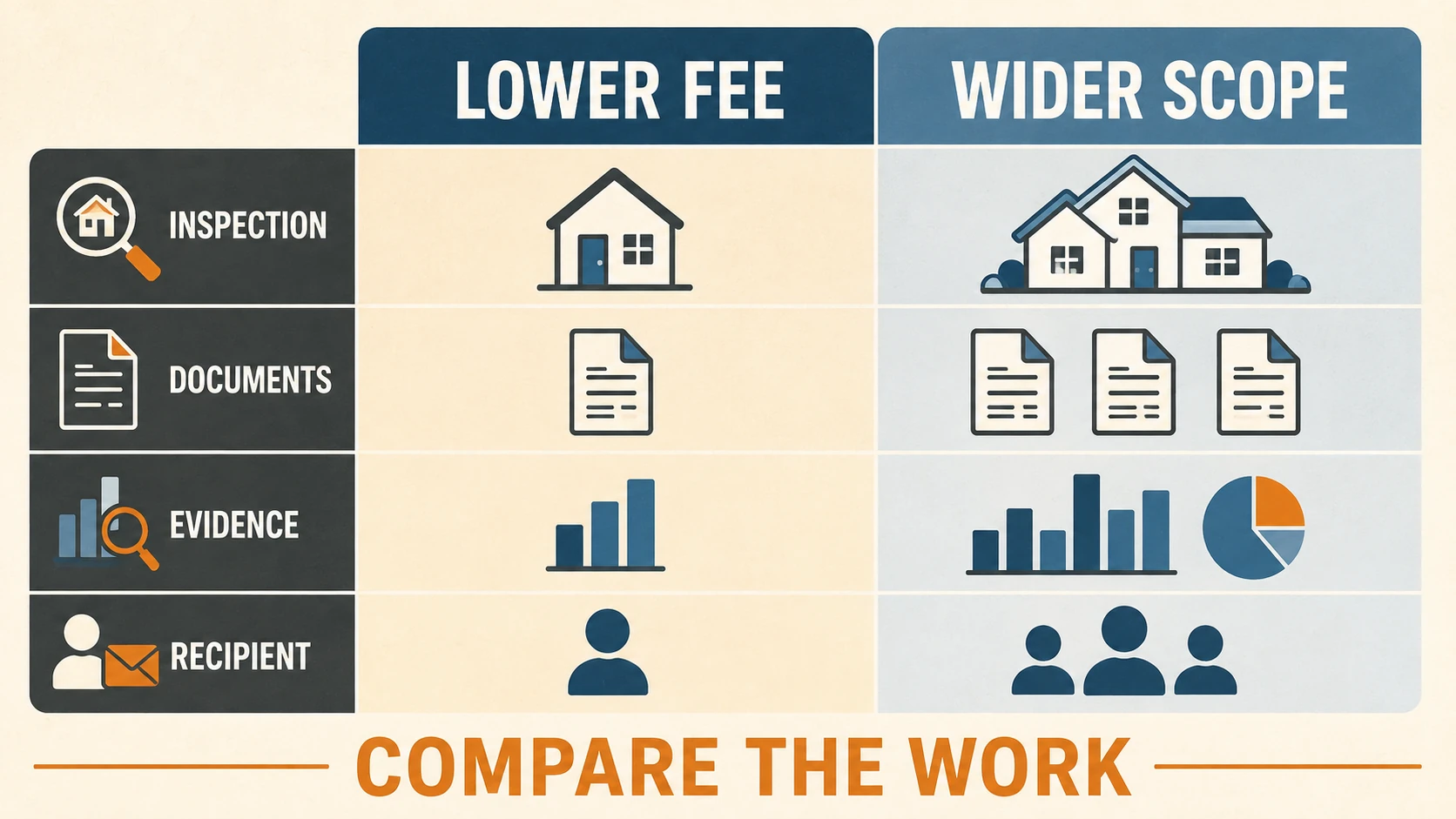
For a fair fee comparison, place the assignment, visit, report, report review and extra work on the same scope line.
TL;DR: compare the work, not just the fee
Choose the lower-fee option only when the stated purpose, recipient, evidence and delivery conditions match the decision. Choose the wider-scope option when the property, rights, condition or recipient require more explanation and supporting evidence.
- A fee-led brief can fit a narrow, clearly defined question.
- A wider-scope brief can fit a lender, dispute, complex property or evidence-heavy decision.
- Both options need a named property, value date, purpose and recipient.
- A lower price does not prove a lower standard, and a higher price does not prove a better result.
- Ask what is inspected, which records are needed, what assumptions apply and what happens when an important fact is missing.
Before you compare the report, align your purpose, recipient and evidence with NRVT residential valuation practice guidance.
For this assignment, keep the relevant property or file facts beside Kadaster sales-information fields before you rely on the conclusion.
When your file raises a related question, compare the facts with what is a property valuation report before you choose the report scope.
When your file raises a related question, compare the facts with property valuation costs Rotterdam before you choose the next step.
Before you compare the report, align your purpose, recipient and evidence with NRVT residential valuation practice guidance.
For this assignment, keep the relevant property or file facts beside Kadaster sales-information fields before you rely on the conclusion.
When your file raises a related question, compare the facts with what is a property valuation report before you choose the report scope.
When your file raises a related question, compare the facts with property valuation costs Rotterdam before you choose the next step.
Quick Context
Property valuation report contents gives a useful vocabulary for property identity, purpose, assumptions and supporting evidence.
A quote becomes comparable only after property valuation costs in Rotterdam are separated from scope, recipient and delivery conditions.
If you are comparing cheap and expensive valuation quotes, test the stated scope against a property valuation in Someren as address evidence, not as a Rotterdam price conclusion.
If the brief still has a gap, contact us about the scope with the purpose and recipient, without sending personal documents.
Who This Comparison Is For
This comparison is for homeowners, buyers, sellers and advisers who are weighing a lower-fee brief against a broader valuation assignment in Rotterdam. It also helps when two quotes use similar labels while asking for different documents or offering different amounts of work.
X vs Y at a Glance
| Criterion | Fee-led brief | Wider-scope brief | What to verify |
|---|---|---|---|
| Best fit | A narrow, known question | A decision with more evidence or parties | Purpose and recipient |
| Scope | Explicitly limited | Broader property, rights or evidence review | Included and excluded work |
| Inspection | Confirm the level of inspection | Confirm the inspection and additional investigation | Who attends and what is recorded |
| Evidence | Minimum relevant evidence | More supporting records and comparables | Evidence list and assumptions |
| Delivery | Defined report or value response | Report with fuller reasoning and limits | Format, timing and revisions |
| Cost model | Lower quoted fee may reflect narrower work | Higher fee may reflect broader work | Itemised inclusions, VAT and extras |
| Risk | A missing input can make the answer too narrow | More work can still miss an unclear purpose | Gaps, conflicts and uncertainty |
The table compares assignment characteristics rather than fixed Rotterdam prices. The quote is useful only when its scope matches the decision.
The comparison should also state the value date and the evidence expected.
Fee-led Valuation Brief
A lower-fee valuation brief can be sensible for a tightly bounded question with straightforward property facts. The request should still state the property, purpose, recipient, relevant date and the evidence that matters. “Cheap” is not a quality category; it describes how the quote is perceived relative to another quote.
Strengths
- The decision can be easier to understand when the scope is narrow.
- The total cost may be easier to compare when inclusions are written down.
- A short evidence chain can reduce unnecessary work for a simple purpose.
Limitations and risks
- A narrow assignment may not answer a later lender, tax, dispute or family question.
- Missing rights, defects, leases or documents can limit the conclusion.
- A report built for one recipient may not satisfy another recipient.
A fee-led brief is a poor fit when the reader is trying to make several unrelated decisions from one number. When the purpose is still unclear, define that purpose before choosing the fee level.
Wider-scope Valuation Brief
A wider-scope assignment can be appropriate when the property has unusual rights, mixed use, complex condition, multiple owners, a formal recipient or a need for more visible reasoning. It should still be proportionate. More pages or more data do not automatically make a conclusion correct.
Strengths
- Relevant property and legal facts can be made visible before the conclusion.
- A formal recipient can see the assumptions, evidence and limitations it needs to assess.
- The assignment can expose missing records before they become a late-stage problem.
Limitations and risks
- Extra scope can add time and cost without answering the actual decision.
- A larger file can create false confidence when evidence is weak.
- A broader brief still cannot decide tax, legal entitlement, lending approval or a family settlement.
The wider option fits when the extra work is tied to a defined risk. Ask which part of the assignment changes and why it matters to the recipient.
Decision framework: six criteria that actually matter
- Purpose. State whether the value supports a mortgage, sale, purchase, tax question, dispute, inheritance or orientation.
- Recipient. Name the lender, adviser, court-related process, family or private decision-maker who will receive the work.
- Property factors. Record apartment rights, leases, mixed use, monuments, structural questions, land rights and unusual condition.
- Evidence burden. Ask whether the answer needs a small set of comparables or a fuller file of records, inspections and assumptions.
- Time and revision. Clarify delivery, missing-document handling and whether a changed purpose requires a new assignment.
- Independence and standards. Ask who performs the work, what professional standard applies and how conflicts are handled.
Use Case-Based Recommendations
A straightforward buyer orientation
A buyer comparing two homes may need a focused value question and a clear evidence boundary. A wider file is justified when the property has an unusual right, uncertain renovation work or a formal lender recipient.
A mortgage or NHG file
The recipient can impose conditions that change the brief. Confirm the accepted standard, report type, timing and required registration before treating a low quote as equivalent to a broader assignment.
A family or business disagreement
A number that must be explained to several people usually needs a visible value date, property identity, rights, evidence, assumptions and limits. The cheapest option may be unsuitable when the missing context is the source of the disagreement.
Risks, Limitations, and Edge Cases
A fee-led brief can fall short when a different recipient, a dispute or missing information appears later. A wider assignment can add needless work when the purpose stays simple. If neither option fits, split the assignment or ask which professional should handle the missing part.
Alternatives, hybrids and neither-fit cases
A value indication can fit early orientation when no formal report is needed. A full valuation can fit a formal decision after the purpose and recipient are known. A hybrid approach can begin with a focused document review and expand only when the facts show that extra inspection or evidence is necessary.
Budget and Scope Recommendations
A lower fee can fit a tightly bounded question; wider scope is worth paying for only when extra evidence, rights, condition or recipient risk changes the decision. No like-for-like public price set supports ranking Rotterdam assignments by amount.
Frequently asked questions
Is the cheapest valuation the best choice?
No. Compare the assignment, evidence, recipient and delivery conditions first. A low fee can be reasonable for narrow work and unsuitable for a formal or complex decision.
Does a higher fee guarantee higher quality?
No. A higher fee may reflect more work, but the work still needs a clear purpose, relevant evidence and a reviewable conclusion. Ask what changes in the scope.
Should every Rotterdam home receive a wide-scope assignment?
No. The proportionate scope depends on the property, purpose, recipient and evidence risk. A simple question can need less work than a dispute or formal financing file.
What if two quotes use the same word for different work?
Ask each professional to state inclusions, exclusions, inspection, documents, assumptions, report format, timing and follow-up in writing. Compare those fields rather than the label.
Can one valuation serve a mortgage and a family buyout?
Only if both purposes, recipients and value dates are accepted by the relevant parties and the professional. A lender, lawyer, tax adviser or mediator may require separate confirmation.
What should happen when an important document is missing?
The missing record should be identified, its effect explained and any assumption recorded. Do not treat an untested assumption as equivalent to inspected evidence.
How We Researched This Comparison
The comparison uses public professional guidance and information about sales data, mortgage purpose and valuation assignments. The review holds purpose, recipient, evidence, inspection, assumptions, delivery and limits in view; current fees and acceptance remain assignment-specific.
Getting Started With Your Choice
Write the decision, recipient, value date, property facts, evidence needs and delivery requirement before requesting a quote. A reliable professional should be able to explain why the proposed scope fits those fields.
Practical Checklist Before You Decide
- The two quotes answer the same purpose.
- The recipient and value date are identical.
- Inspection, documents and evidence are stated.
- Assumptions and limitations are visible.
- Extra work, timing and follow-up are clear.
- The conclusion will be used only for the decision it was prepared to support.
Write the purpose, recipient, value date, property details, expected evidence and delivery deadline beside each quote. Ask what is included and excluded before comparing the amounts. Contact us with a scope question; do not send passports, contracts, bank details or other personal documents through the public form.
Contact us about valuation scope