Property valuation for inheritance tax in the Netherlands: how to prepare the value question
Prepare a property valuation after an inheritance by separating the tax value, market value, ownership, debt, value date and family decision.

If you are preparing a property valuation for inheritance tax, write down the purpose, recipient and value date before you compare the available evidence. A property inherited after a death can carry several value questions at once. The tax return, a buyout between heirs and a later sale may each use different facts or dates. A useful valuation brief names the purpose first, fixes the relevant date, separates ownership and debt, and states what the valuer has not been asked to decide.
If an inherited property is involved, name the tax, distribution or sale decision and its relevant date before comparing values.
TL;DR: fix the question before the number
For Dutch inheritance tax, the Belastingdienst distinguishes between the value of the estate and the way a home is valued. For a home, the WOZ value for the year of death or the following year can be relevant, with the lower value used when both are available. Changes to the home before the death, a non-residential property, a lease or a different family decision can require a different evidence chain. The tax position belongs with a tax professional.
An inheritance valuation is most useful when the family needs a stated value for a defined purpose, such as a buyout or a sale discussion. It does not calculate inheritance tax, settle ownership or replace a will, deed, lender decision or legal advice.
Before you compare the report, align your purpose, recipient and evidence with Belastingdienst buy-out information.
For this assignment, keep the relevant property or file facts beside Belastingdienst buy-out information before you rely on the conclusion.
When your file raises a related question, compare the facts with property valuer in Rotterdam before you choose the report scope.
When your file raises a related question, compare the facts with what is a property valuation report before you choose the next step.
Before you compare the report, align your purpose, recipient and evidence with Belastingdienst buy-out information.
For this assignment, keep the relevant property or file facts beside Belastingdienst buy-out information before you rely on the conclusion.
When your file raises a related question, compare the facts with property valuer in Rotterdam before you choose the report scope.
When your file raises a related question, compare the facts with what is a property valuation report before you choose the next step.
Context that informs this decision
If you need local help framing the assignment, property valuer in Rotterdam gives the local context for a defined residential valuation question.
Property valuation report contents helps you identify those fields when checking the delivered document.
When quotes arrive, property valuation costs in Rotterdam become comparable only after scope, recipient, value date and delivery conditions are stated.
If you are assessing an inherited property, keep inheritance-tax questions separate from the address evidence in a property valuation in Asten and tie the Rotterdam conclusion to its own value date.
If the ownership or property facts remain unclear, contact us about an inheritance valuation with a short question and no personal documents.
Who this is for
This preparation fits heirs, an executor, a surviving co-owner and a family deciding what to do with a home or another property. It is also useful when one person wants to keep the property and the others need a neutral value discussion.
The first question is not “What is the property worth?” It is “Which decision will this value support, for whom and on which date?” That sentence keeps a tax value, a market value and a settlement number from being mixed together.
Records to gather
Collect the facts without sending personal documents through a public contact form:
- The death date and the date on which the value is needed.
- The address, property type, floor area, plot or other rights and known changes.
- The ownership shares from the deed, will or estate records.
- The mortgage balance, secured debt and any lease or tenancy arrangement.
- The relevant WOZ letters and the intended use of the valuation.
The report itself should make clear which facts were supplied, which were inspected and which were assumed.
Which value question applies?
Check purpose, date, property identity, rights, evidence, method, assumptions and limits.
Keep the tax question with the tax adviser and the legal question with the notary or lawyer.
Before asking for a valuation, write the property, purpose, recipient, value date, ownership question and known constraints in one concise brief.
A home for an inheritance-tax return
The official tax rule for an inherited home looks at a WOZ value connected to the year of death or the following year when that value is available. The lower of the two can be used. A home that was materially changed before the death can call for a market-value assessment instead. A tax adviser should confirm which rule applies to the estate and return.
A home one heir wants to keep
A buyout discussion needs a value at an agreed date, ownership shares, mortgage debt and the conditions of the transfer. The number used in a family calculation can differ from the number used for a tax return. Set those purposes out separately before comparing a share or equalisation amount.
A property the heirs plan to sell
The sale question needs a market view, a clear value date and a realistic record of condition, occupancy, rights and costs. A valuer can provide an opinion of value under the stated assumptions. The selling process, notary work, debt settlement and tax treatment remain separate decisions.
A rented, leased or non-residential property
The property use changes the evidence. The Belastingdienst provides a separate calculation for some rented or leased homes, while a business property is generally treated through market-value evidence rather than the home rule. State the use, rights, income and restrictions in the assignment.
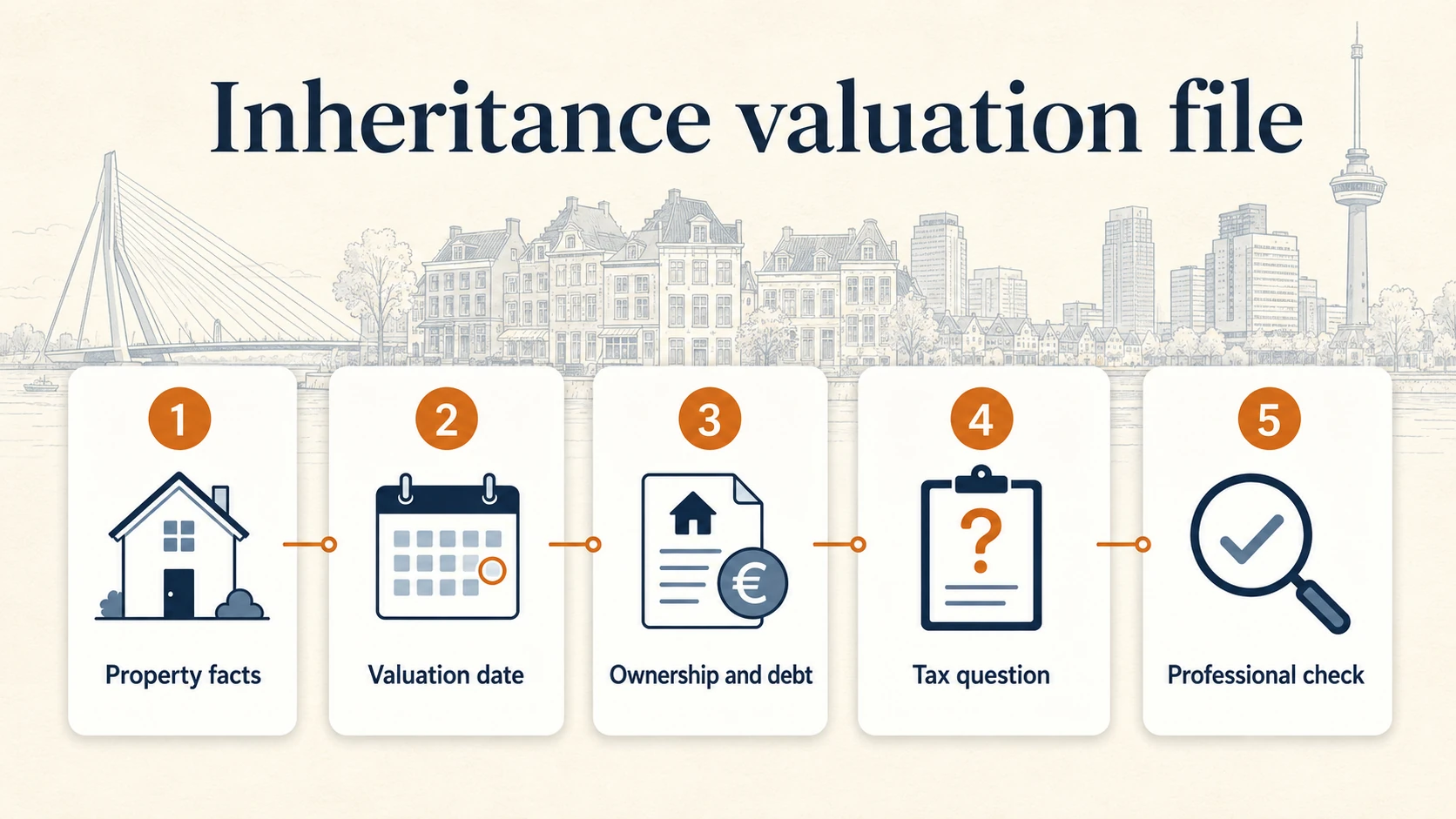
A five-step assignment
1. Name the purpose and recipient
Write one sentence such as: “We need an independent valuation of this residential property for a family buyout at the agreed value date.” Add the recipient and the decision that follows. A tax return, lender file, sale and family negotiation should not be hidden in one vague request.
2. Fix the value date
A current inspection does not automatically create a value at the death date. Ask how historical condition, improvements, market evidence and missing records will be handled. Record the difference between inspection date, value date and report date.
3. Prepare the property file
List the physical facts, rights, occupancy, improvements, defects and relevant comparable evidence. Separate verified facts from family recollection. If a record is missing, say so and ask what assumption will be used.
4. Separate ownership and debt
The value of the property is one input. The ownership share, mortgage balance, other secured debt and transfer costs are separate inputs. A report should not quietly turn a market value into a personal settlement calculation.
5. Review the conclusion against the brief
Scenarios that change the preparation
One heir keeps the home
Agree the value date before discussing the buyout. Ask the lender whether the remaining borrower can carry the mortgage and ask a legal professional how the transfer should be documented. A family spreadsheet can show the inputs, but it cannot decide whether an agreement is legally or fiscally suitable.
The heirs sell together
Give the valuer the intended purpose and any known occupancy or sale constraints. A sale price will depend on the later marketing and transaction, so keep an opinion of value distinct from an advertised asking price or a guaranteed result.
A tenant or lease is involved
Occupancy rights, rent, term and restrictions can affect the evidence. Do not assume the ordinary owner-occupied home rule applies. Ask the tax adviser which value belongs in the return and ask the valuer which facts are needed for the stated opinion.
Common mistakes
- Using a current WOZ value without checking the relevant value date.
- Mixing the value for inheritance tax with a value for a buyout.
- Giving only a street address and omitting ownership, debt or occupancy.
- Treating a report as a legal division agreement.
- Comparing quotes that have different purposes, recipients or delivery conditions.
After the report
Keep the final report with the estate records and note which version was used in a tax or family conversation. If the purpose changes, ask whether a new assignment is needed. If the property changes, the value date changes or a legal agreement is signed, the earlier conclusion may no longer answer the new question.
Frequently asked questions
Is a property valuation always needed for inheritance tax?
No single answer applies to every estate. The tax authority has specific rules for inherited homes and other property. Confirm the relevant value with a tax adviser before commissioning work that does not match the return.
Can a valuer calculate the inheritance tax?
A valuer can provide an opinion of value under an agreed brief. Inheritance tax, exemptions, debts and the return belong with a tax professional.
Can one report set the buyout and tax values?
It can provide evidence for more than one conversation only when each purpose and date is stated. Ask the valuer and adviser whether one assignment covers both questions.
What if the family cannot agree on the value date?
Pause the calculation and write down the competing purposes. A notary, lawyer or mediator can help the family define the agreement; the valuer can then receive a clear technical brief.
A useful final check
Write down the death date, property use, ownership share, debt and the exact decision the value should support. A tax adviser or legal professional may need to confirm the next step. Contact us with a valuation-scope question; do not send passports, contracts, bank details or other personal documents through the public form.
Contact us about an inheritance valuation