Valuation for new-build and structural inspection
Understand how a new-build valuation differs from a structural inspection, which documents matter and what NHG 2026-1 says to check.

A new-construction valuation and a structural inspection answer different questions. The valuation supports a market-value and mortgage file. The structural or building inspection examines condition, defects and possible repair work. For an unfinished home, the documents may carry more weight because the valuer cannot assess every finished feature on site.
For a new-construction file, separate contract costs, chosen extras, construction stage and building-condition questions before you request work.
TL;DR: two files, two questions
Keep the assignments separate:
- Valuation file: what is the market value for the stated purpose and date, based on the contract, specification, costs and relevant market evidence?
- Condition file: what is the building’s condition, which defects need attention and what additional investigation may be sensible?
The lender may require one report, both reports or another form of evidence. Ask the recipient before commissioning either assignment. A structural report cannot be assumed to satisfy a valuation requirement, and a valuation is not a substitute for a detailed building inspection.
Request the lender’s valuation and inspection instructions before arranging either assignment.
Then reconcile the purchase agreement, specification, options and construction documents.
Before you compare the report, align your purpose, recipient and evidence with NHG valuation requirements.
For this assignment, keep the relevant property or file facts beside NHG valuation requirements before you rely on the conclusion.
When your file raises a related question, compare the facts with valuation when buying a property step by step before you choose the report scope.
When your file raises a related question, compare the facts with new-construction home valuation Rotterdam before you choose the next step.
Before you compare the report, align your purpose, recipient and evidence with NHG valuation requirements.
For this assignment, keep the relevant property or file facts beside NHG valuation requirements before you rely on the conclusion.
When your file raises a related question, compare the facts with valuation when buying a property step by step before you choose the report scope.
When your file raises a related question, compare the facts with new-construction home valuation Rotterdam before you choose the next step.
Context that informs this decision
property purchase valuation steps define the buyer sequence, while NHG physical and hybrid conditions distinguish the two report forms.
For the valuation file itself, new-construction valuation documents identify the contract, extras and completion information needed by the lender or valuer.
When preparing a new-construction or inspection file, compare its document questions with a property valuation in Son en Breugel while keeping the building evidence tied to the actual address.
If you want help framing the value question, contact us with the lender’s wording.
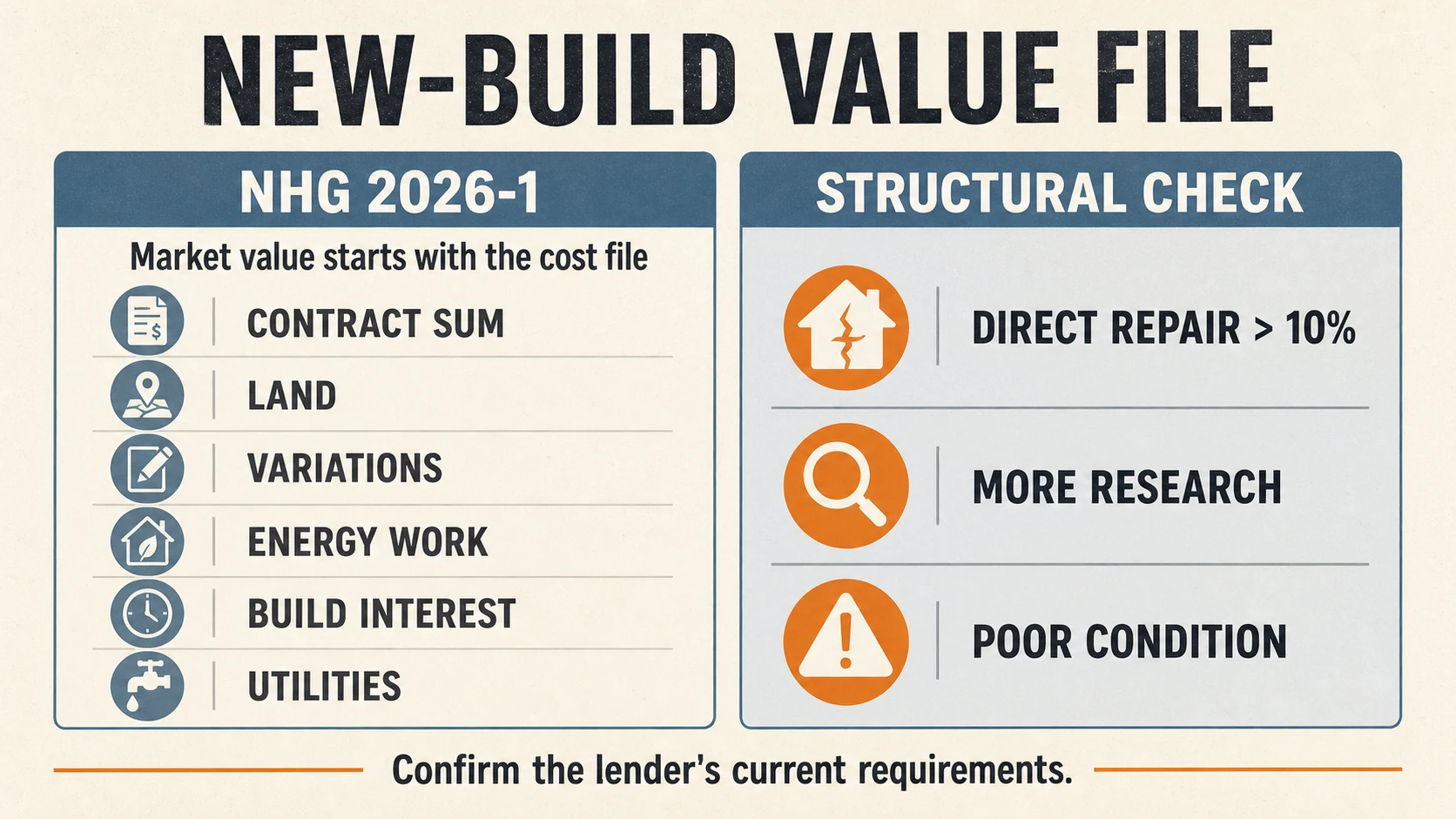
The NHG Conditions and Standards 2026-1 describe a calculation in which the market value of a new-construction home is established by adding the purchase and construction sum or an accepted construction budget.
Who needs this explanation?
This explanation is for:
- buyers of a new-construction property in Rotterdam or elsewhere in the Netherlands;
- applicants arranging a mortgage with a new-construction purchase or construction agreement;
- buyers who need to coordinate a valuation with a building inspection;
- readers who have seen NHG 2026-1 mentioned in their lender’s requirements.
It is not a technical inspection, a construction warranty review or a mortgage approval.
Why is new-construction valuation different?
With an existing home, the valuer can inspect the completed building and compare it with market evidence. With a new-construction purchase, the home may be under construction or not yet started. The file needs a clear description of what is being bought, what is included and which additional costs belong to the project.
The purchase and construction agreement, specification and options list help define the subject. Land rights, utility connections, energy measures, construction interest and buyer choices can also affect the file. The useful test is whether an item is included in the agreed sum, belongs to the relevant purpose and is accepted by the receiving party.
new-construction purchase terms can also differ from an existing-home transaction. Rijksoverheid explains that new-construction homes are usually sold vrij op naam, while other purchase costs and professional services can still need checking. Read the contract and ask the adviser what the stated price includes.
What should the valuation cover?
Purpose and valuation date
State whether the report is for a mortgage connected to a purchase, an improvement or another purpose. Confirm the valuation date and any report-age condition. The lender’s current instruction determines the required form.
Contract and specification
Provide the signed or preliminary version purchase and construction agreement if the lender allows that stage, the technical specification, drawings, options and variations. Identify work that is included, selected separately, provisional or not yet decided.
Market value and cost evidence
The valuer uses the project information together with relevant market evidence. Cost inputs can help establish the subject and its value, but a list of costs is not by itself a promise that the market will value the home at the same total.
Ownership and rights
Include information about the land, leasehold, parking, storage, apartment rights or other rights connected to the property. The exact documents depend on the project and legal structure.
NHG 2026-1: the new-construction cost file
When those items are not already included, the list can also include:
- land or the relevant berth;
- the balance of variations and options;
- energy-saving provisions;
- construction interest and interest loss during construction;
- utility connections;
- construction costs.
This is a checklist for the stated NHG standard, not a reason to add every item twice. Compare the contract, specification and cost breakdown to see what the purchase and construction sum already contains. The binding offer date and current standard control the actual file.
NHG 2026-1 also defines loan-to-value as the relationship between the loan size and the home’s market value. The lender must apply its own current calculation and acceptance process. A cost file does not guarantee a value or a mortgage.
What does the structural inspection check?
A structural inspection or building report focuses on condition. Depending on the assignment and project stage, the inspector may examine accessible construction elements, defects, maintenance needs, workmanship or questions raised by the documents. Ask the inspector to define what can and cannot be assessed before the visit.
NHG 2026-1 says that a building report is needed in certain existing-home situations, including when the average of the total estimated direct repair costs is more than 10% of market value free of rent and use, when more building research is needed or when the building condition is poor. That 10% figure is a trigger in a specific NHG building-report context. It is not a universal pass or fail score for every new-construction inspection.
The lender can require a building report even when a particular NHG condition does not. Conversely, a project can have its own technical inspection, handover review or warranty process. Ask the lender and builder which documents belong in the mortgage file and which belong in the construction process.
Documents to prepare
Create two linked checklists:
Valuation and mortgage file
- purchase and construction agreement;
- specification, drawings and selected options;
- variation or buyer-choice summary;
- land, leasehold, parking and storage information;
- energy provisions and relevant certificates or commitments;
- utility connection and construction-cost details when applicable;
- lender instruction showing purpose, form, date and report review.
Condition and construction file
- technical description and construction schedule;
- builder, warranty or handover information supplied for the project;
- questions about unfinished or inaccessible elements;
- photographs or notes from an allowed inspection stage;
- any earlier technical report or defect list;
- the inspector’s scope and delivery requirements.
Do not fill gaps with assumptions. Mark an item as included, excluded, provisional or unknown and ask the relevant party for confirmation.
A coordination sequence that avoids crossed wires
- Ask the lender first. Confirm the valuation form, purpose, date, report review and whether a building report is required.
- Map the contract. Mark every cost and option as included or separate.
- Choose the inspection scope. Ask a qualified building inspector what can be assessed at the current construction stage.
- Share consistent facts. Give the valuer and inspector the documents that belong to each assignment.
- Review open questions. If the report identifies missing evidence, return to the lender, builder or adviser rather than guessing.
- Keep the reports separate. Deliver each report to the party that requested it and store the date and purpose with the file.
Three practical situations
The contract is complete but options are still open
Ask the lender how provisional options should be treated. Do not describe an undecided choice as completed work. The valuation file should make the status of each cost clear.
The building cannot be fully inspected yet
Ask the inspector what can be observed now and what must wait until handover. The valuation can rely on documents for parts of the project, but the lender may still require a later check.
A report raises a quality question
Keep the valuation conclusion separate from the repair question. Ask the builder, inspector, lender or adviser who is responsible for the next answer. A valuer can identify a value-relevant issue without providing a construction remedy.
Common mistakes
- Treating the valuation as a building warranty review.
- Adding options or utility costs twice because the contract is unclear.
- Ordering a report without confirming the lender’s purpose and date.
- Treating the 10% NHG building-report context as a universal inspection score.
- Assuming a technical inspection satisfies the lender’s valuation requirement.
- Describing planned or provisional work as finished.
- Forgetting land, leasehold, parking or apartment-right documents.
- Using an old standard without checking the binding-offer date.
Frequently asked questions
Is a new-construction valuation the same as a building inspection?
No. The valuation addresses market value for a stated purpose. The building inspection addresses condition, defects and possible repairs. A lender can ask for both.
What does NHG 2026-1 say about new-construction value?
It lists the purchase and construction sum or accepted construction budget and adds specified costs when they are not already included. Check the current standard and your contract because the list is not an instruction to count an included cost twice.
Does every new-construction purchase need a physical visit?
The required form depends on the lender, product, purpose, project stage and current standards. Ask the receiving party before commissioning the report.
Is the 10% figure a general building rule?
No. In NHG 2026-1 it appears in a specific context for when a building report is needed for an existing home, based on average estimated direct repair costs and market value. It is not a general pass or fail threshold for every inspection.
Can the builder’s documents replace the valuation?
They can support the valuation file but do not automatically replace the report a lender requires. Confirm the accepted evidence with the lender.
Who should inspect unfinished work?
Ask a qualified building inspector or the project process owner which inspection is appropriate at that stage. The valuer’s scope is different.
Can a lender ask for a report even if NHG does not?
Yes. The lender may apply its own product and risk policy. Ask for the current written requirement.
Next step
Ask the lender which valuation form, purpose, date and validation it accepts for the new-build file. Ask separately who should perform any structural or building inspection and which contract documents the inspector needs. Contact us with the lender's wording if you are unsure which question belongs to the valuation.
Ask about a new-build valuation →